

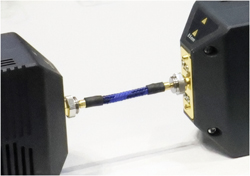
Figure 1 MWX0A5 cable connected to Keysight extenders.
The rapid expansion of AI accelerators and high performance data center interconnects is driving increased research and development activity in the mmWave and sub-terahertz (sub-THz) frequency ranges. These emerging applications impose stringent requirements on bandwidth, latency and signal integrity that extend well beyond the capabilities of traditional RF measurement infrastructures. While advances in vector network analyzers (VNAs) and frequency-extension technologies (see Figure 1) have enabled measurements beyond 110 GHz, overall measurement accuracy is increasingly limited by interconnect performance rather than instrument capability. At mmWave and sub-THz frequencies, phase instability, insertion loss, mechanical repeatability and connector robustness of coaxial cable assemblies become dominant contributors to measurement uncertainty. This article examines the role of cables and connectors as critical measurement enablers in DC to 250 GHz test systems and discusses the physical mechanisms that drive interconnect-induced measurement errors, with emphasis on phase stability, mechanical sensitivity and repeatable high frequency device characterization.
INTRODUCTION
The continued expansion of AI-driven computing and data-intensive applications has significantly increased demand for higher bandwidth interconnect technologies. Data centers, central to the modern digital ecosystem, are undergoing rapid architectural evolution to accommodate escalating traffic volumes and increasing latency-sensitive workloads. Although optical links remain the dominant solution for long-reach data transport, growing limitations in electrical interconnect scalability, power consumption and signal integrity are motivating increased exploration of mmWave and sub-THz solutions for short-reach and intra-system connectivity.
These trends place new demands on RF and microwave test and measurement systems. Accurate characterization of devices, modules and subsystems operating above 110 GHz requires not only advanced instrumentation, but also highly stable and repeatable interconnects. In this frequency regime, cables and connectors can no longer be treated as secondary accessories; instead, they become integral components of the measurement system that directly influence achievable accuracy, repeatability and confidence in measured results.
MMWAVE AND SUB-THZ SYSTEM DRIVERS
Emerging AI and machine learning compute architectures continue to drive increasing bandwidth requirements, reinforcing the need for next-generation interconnect solutions. Operation in the mmWave (30 to 300 GHz) and sub-THz frequency ranges offers a potential path toward higher data rates through short-range wireless or quasi-wireless links. These approaches are supported by ongoing advances in RF integrated circuits, advanced packaging and heterogeneous integration technologies.
Fully digital mmWave transceivers incorporating high speed data converters and beamforming capabilities are expected to play an important role in future 6G and beyond wireless systems. At sub-THz frequencies, however, losses and parasitic effects scale rapidly with frequency, making co-optimization of circuits, packages and interconnects essential. Measurement fidelity in this frequency range is therefore critical for validating both device-level performance and overall system architectures.
MEASUREMENT CHALLENGES ABOVE 110 GHZ
While frequency-extension techniques have expanded the usable range of modern VNAs well beyond 110 GHz, practical measurement accuracy at these frequencies is increasingly dominated by interconnect limitations. Key contributors include elevated insertion loss, phase instability, connector wear and limited mechanical robustness of test cables and interfaces. These effects increase sensitivity to handling, temperature variation and calibration repeatability.
As operating frequency increases, electromagnetic wavelengths shrink to the millimeter and sub-millimeter scale. Under these conditions, even small mechanical or material variations within the measurement setup can produce measurable electrical effects. As a result, maintaining stable and repeatable interconnecting performance becomes one of the primary challenges in mmWave and sub-THz test environments.
PHASE STABILITY AND MECHANICAL SENSITIVITY
Coaxial cable assemblies remain widely used in mmWave and sub-THz test systems due to their shielding effectiveness, controlled impedance and compatibility with precision connector interfaces. However, it is well known that the amplitude and phase response of a coaxial transmission line can vary as a function of mechanical bending, routing and environmental conditions.
These variations arise primarily from small changes in the effective dielectric constant caused by mechanical deformation or temperature fluctuations, which, in turn, alter signal propagation delay. At sub-THz frequencies, even very small phase perturbations can translate into significant amplitude ripple and degraded measurement repeatability. Consequently, cable phase stability under flexure and thermal stress becomes a critical parameter in high frequency measurement environments, particularly for applications requiring frequent reconnection or cable movement.
IMPLICATIONS FOR DC to 250 GHZ TEST SYSTEMS
In advanced mmWave and sub-THz measurement systems extending to 250 GHz, cables and connectors must be treated as precision components rather than passive accessories. Highly phase-stable, low loss coaxial cable assemblies with mechanically robust, repeatable connector interfaces are essential for minimizing measurement uncertainty and ensuring consistent results.
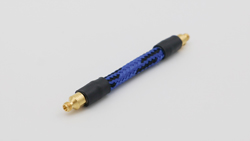
Figure 2 MWX0A5 cable.
From a system-level perspective, interconnect performance directly affects calibration validity, long-term measurement stability and confidence in extracted device parameters. As operating frequencies continue to increase, the selection, qualification and handling of coaxial cable assemblies will play an increasingly important role in enabling accurate device characterization and reliable system validation.
INTRODUCING JUNKOSHA MWX0A5 0.5 MM CABLE & ACCESSORIES
Junkosha is supporting the industry as it moves toward higher frequencies, including the development and introduction of 0.5 mm cables, as shown in Figure 2. Junkosha offers assemblies with 0.5 mm male and female connectors. They also offer adapters for 0.5 mm female to 1.0 mm male or female, allowing engineers to integrate the new equipment into existing systems. To maintain repeatability and increase durability with such small center pins, Junkosha is leveraging its expertise to develop a proprietary safety-lock mechanism that guides engagement prior to pin insertion, significantly reducing the risk of bent or damaged contacts. This becomes critical as connector durability directly impacts system connectivity, repeatability and long-term measurements.
The return loss and insertion loss performance of the Junkosha® Microwave/mmWave Coaxial Cable Assembly MWX0A5 are shown for reference only in Figures 3 and 4, respectively.
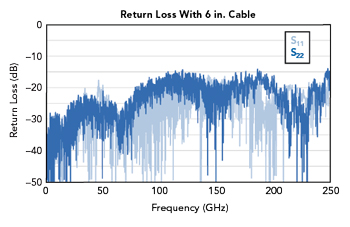
Figure 3 Return loss of Junkosha MWX0A5 cable up to 250 GHz.
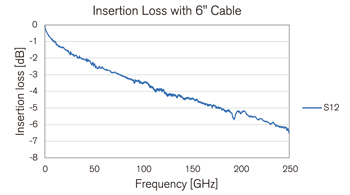
Figure 4 Insertion loss of Junkosha MWX0A5 cable up to 250 GHz.
Equally important is system integration. The availability of 0.5 mm to 1.0 mm adapters simplifies test setups by allowing compatibility with existing devices while maintaining sub-THz performance. Supplying both the cable and adapter as a unified solution, Junkosha reduces interface variability and supply-chain mismatches that often degrade measurement accuracy.
CONCLUSION
As mmWave and sub-THz technologies mature in response to AI-driven and data-centric applications, the limitations of traditional measurement approaches become increasingly evident. Above 110 GHz, interconnect performance often emerges as a dominant factor in overall measurement accuracy, frequently surpassing instrument capability as the primary source of uncertainty. This article highlights the critical role of cables and connectors in DC to 250 GHz test systems and underscores the importance of phase stability, mechanical robustness and repeatability. Continued progress in high frequency measurement will depend not only on advances in instrumentation, but also on ongoing innovation in precision interconnect technologies.
References
- T. S. Rappaport et al., “Wireless communications and applications above 100 GHz: Opportunities and challenges,” IEEE Access, Vol. 7, 2019, pp. 78729–78757.
- P. Hillger et al., “Towards mobile terahertz communication systems,” IEEE Journal of Selected Topics in Quantum Electronics, Vol. 26, No. 1, Jan. 2020.
- G. F. Engen and C. A. Hoer, “Thru-reflect-line: An improved technique for calibrating the dual six-port automatic network analyzer,” IEEE Transactions on Microwave Theory and Techniques, Vol. 27, No. 12, Dec. 1979.
- D. F. Williams, Calibration and Measurement of Millimeter-Wave Devices, NIST Technical Note 1520, 2006.
- J. Verspecht and D. F. Williams, “Calibration of millimeter-wave vector network analyzers,” IEEE Microwave Magazine, Vol. 17, No. 1, Jan. 2016.