

Significant advances in technology during the past 30 years have enabled humanity to achieve the goal of connecting anyone, anytime, anywhere on the planet. It began with the commercialization of mobile phones and the evolution from analog voice to digital data. In parallel, the development of much lower-cost and consequently more frequent rocket launches enabled constellations of satellites to cover the globe. In low Earth orbit (LEO) and very low Earth orbit (VLEO), the lower radiation levels and shorter mission lifetimes reduce the need for traditional, space-qualified components, enabling the use of commercial semiconductors and significantly lowering satellite payload costs.
Successful commercialization of these LEO systems is evident from the services offered by Starlink, orbiting approximately 9000 satellites, and Eutelsat OneWeb, with 660 satellites. Amazon is developing Amazon Leo, a constellation numbering more than 3000, and Starlink plans another 7500 satellites in VLEO. These systems provide broadband data services using user terminals developed for each constellation. A new generation of constellations promises a direct connection between the satellite and mobile phones. AST SpaceMobile’s phased array satellite is designed to receive signals directly from phones and relay them through a ground gateway back through the mobile operator to the cloud.
To provide the high data rates users expect, satellite systems require wide bandwidth gateway channels. To support the ever-increasing demand for data, which is accelerating with AI, satellite systems are moving gateway links from Ku- and Ka-Band to higher mmWave bands, such as V- and E-Band.
Responding to this shift, mmTron has introduced high linearity power and low noise amplifiers (LNAs) for the V-Band satellite downlink. Covering 37 to 44 GHz, the amplifiers maximize linearity for high data rates and high efficiency to minimize satellite power consumption. They are fabricated on a space-qualified GaN process, which combines the power and efficiency advantages of GaN with the reliability pedigree for satellites.
TMC315 POWER AMPLIFIER
Covering 37 to 44 GHz, mmTron’s TMC315 power amplifier (PA) provides 39 dBm output power at 1 dB compression and 40 dBm saturated. To enable closed-loop control of the output power, the PA has an integrated, temperature-compensated power detector.
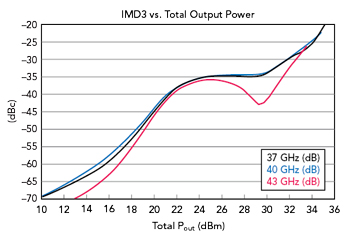
Figure 1 TMC315 measured IMD3 versus total output power at 37, 40 and 43 GHz.
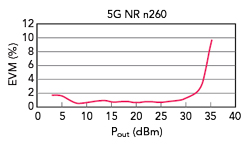
Figure 2 TMC315 EVM performance with a 5G NR signal in the n260 band.
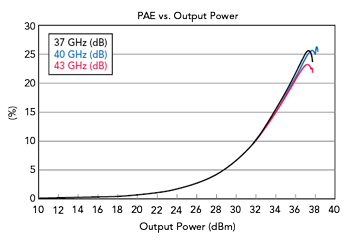
Figure 3 TMC315 measured PAE vs. output power at 37, 40 and 43 GHz.
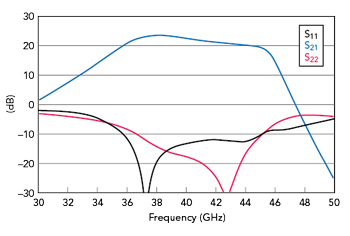
Figure 4 TMC315 small signal gain and return loss versus frequency.
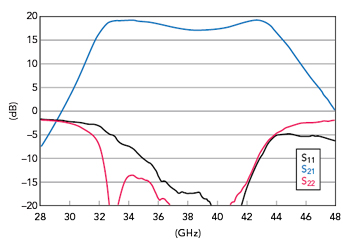
Figure 5 TMC316 small signal gain and return loss versus frequency.
Demonstrating the linearity of the TMC315, the third-order intermodulation (IMD3) is better than -33 dBc at 31 dBm output (see Figure 1), and the third-order output intercept point (OIP3) is 44 dBm. Driven with a multi-carrier 5G NR modulated signal in the n260 band (37 to 40 GHz), the error vector magnitude (EVM) measures below 2 percent up to 32 dBm output (see Figure 2).
In addition to high linearity, the PA achieves a power-added efficiency (PAE) of approximately 25 percent, as shown in Figure 3. High PAE is important to minimize satellite power consumption and simplify the thermal design of the payload.
With three amplifier stages, the TMC315 provides greater than 20 dB small signal gain and better than 10 dB return loss across the operating frequency range (see Figure 4).
The PA maintains output power, linearity and efficiency performance across a wide range of drain bias, from 18 to 28 V, offering flexibility to system designers.
TMC316 DRIVER/LNA
The TMC316 amplifier is the second amplifier mmTron is introducing. With frequency coverage from 32 to 44 GHz, it can be the driver amplifier for the TMC315 or used as a standalone LNA.
The TMC316 provides 27 dBm output power at 1 dB compression and 28 dBm saturated, with 32 dBm OIP3. The small signal gain is 17 dB (see Figure 5), and the noise figure is 5.5 dB.
Like the TMC315, the TMC316 maintains good output power, linearity and efficiency across a wide range of drain bias, from 18 to 28 V.
BARE DIE, TAB AND PACKAGED OPTIONS
Both amplifiers are available as bare die, mounted on tabs or packaged in air-cavity, 5 × 5 QFNs. The TMC315 die measures 3.0 × 2.5 × 0.1 mm and the TMC316 is 3.0 ×1.5 × 0.1 mm.
With the tab configuration, the amplifiers are soldered to CuMoCu tabs, ensuring a void-free attachment to a high thermal conductivity base that removes heat from the device and reduces channel temperature, extending lifetime. The coefficients of thermal expansion of the CuMoCu tab and the amplifier’s SiC backside are well matched, which ensures mechanical reliability with temperature changes.
These V-Band amplifiers are the latest products in mmTron’s large portfolio of MMIC products, including mmWave PAs and LNAs, wideband distributed amplifiers covering DC to 180 GHz, front-end modules, mixers, multipliers, multi-function ICs and interfaces for high speed data converters.
mmTron’s recognized expertise is highly linear and efficient mmWave PAs for satcom, fixed wireless access and other high data rate mmWave communications systems. mmTron’s wide bandwidth products are also used in aerospace and defense and instrumentation.
mmTron, Inc.
Redwood City, Calif.
www.mmtron.com