

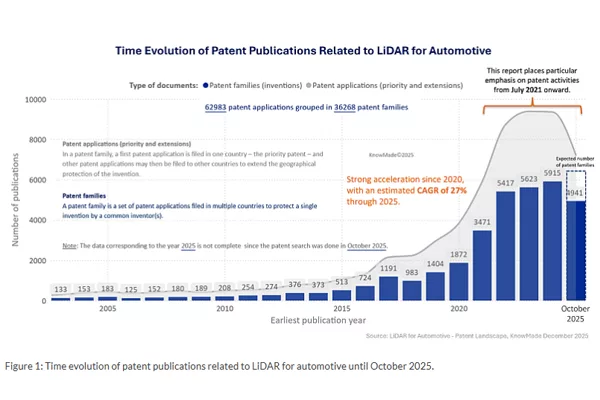
KnowMade announced the release of its latest patent landscape report, "LiDAR for Automotive – Patent Landscape Analysis 2025," a comprehensive study capturing how global innovation and intellectual property (IP) strategies are shaping the future of LiDAR technologies for ADAS and autonomous vehicles. As LiDAR transitions from an advanced sensor option to a core enabler of vehicle perception, patenting activity has accelerated at unprecedented speed. As of October 2025, the global patent landscape for automotive LiDAR includes more than 36,200 patent families (inventions) and over 62,900 individual patents. LiDAR patent filings have tripled since 2021, underscoring the sector’s rapid move from initial research to full-scale industrial deployment. Between 2020 and 2025, patent activity shows an estimated CAGR of 27 percent, reflecting the strong and accelerating pace of innovation in this field.
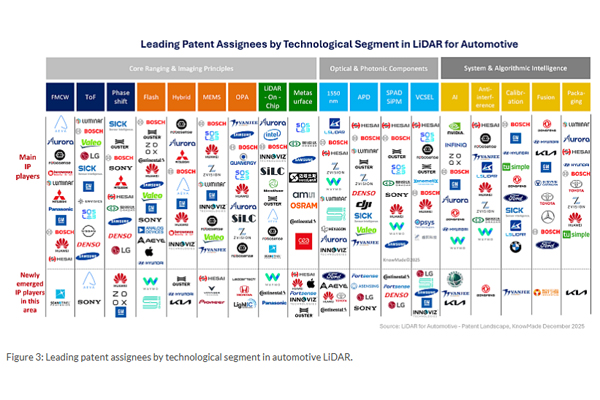
Innovation now spans all layers of the LiDAR technology stack: ranging principles (ToF, FMCW), beam steering architectures (MEMS, hybrid scanning, OPA, flash), photonic integration, advanced detectors (1550 nm, VCSEL, SPAD/SiPM, APD), packaging, calibration and increasingly AI-driven perception and fusion. This broadening of technical domains demonstrates a transition from early research toward large-scale IP consolidation, with companies striving to secure strategic positions in high-growth segments such as FMCW, integrated photonics and solid-state architectures.
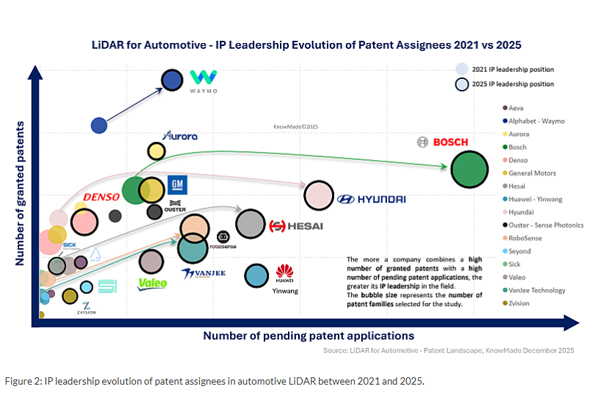
The expansion also reflects a rapidly diversifying ecosystem comprising LiDAR pure players, Tier-1 suppliers, automotive OEMs, autonomous-driving developers, semiconductor companies and research institutes. Their collective activity highlights the growing maturity of LiDAR technologies and a stronger alignment between IP strategies and long-term technological roadmaps. LiDAR pure players in particular are reshaping competitive dynamics. Chinese companies such as Hesai, RoboSense, Huawei Yinwang, VanJee, Zvision, Benewake and Leishen Intelligent remain active across all major LiDAR technology domains and show significant momentum from 2021 to 2025, with marked increases in granted patents and recent filings. In parallel, the United States continue to play a central role through General Motors, Alphabet-Waymo, Aurora, Ouster, Seyond and Aeva. Europe contributes substantial IP activity through its automotive and photonics sectors, driven by Bosch, Continental, Valeo and several OEMs focusing on components, packaging, calibration and vehicle-grade LiDAR integration. Japan and South Korea maintain consistent participation through Sony, Denso, Toyota, Samsung, Infoworks and Hyundai-Kia.
Report Highlights
Report Package
- 160+ slide PDF report
- Methodology, executive summary and full patent landscape analysis
- Extensive Excel database with all patent families analyzed in this study
- One-hour online presentation with the report’s author (results + Q&A).
Patent Landscape Overview
- Global IP trends and publication time-evolution
- Geographic distribution of patent filings
- Major patent assignees and ecosystem timeline
- Newcomers driving recent innovation
- IP leadership evolution (2021 vs 2025)
- Geographic coverage of top players’ patent portfolio
- High-impact patent assignees and notable IP portfolios
- IP ecosystems including co-owned patent, including group-internal and external collaboration, etc.
- U.S. litigations and legal status insights.
Technology Segmentation & Innovation Layers
The report provides a detailed segmentation of patents across all major LiDAR approaches, including:
- Core Ranging & Imaging Principles: Pulsed ToF, FMCW, phase-shift ranging, MEMS and hybrid scanning, OPA and flash architectures, metasurface and nanophotonic beam steering, photonic-integrated LiDAR
- Optical & Photonic Components: 1550 nm laser sources, VCSEL arrays, SPAD/SiPM detectors and APDs
- System & Algorithmic Intelligence: Solid-state packaging, calibration, interference mitigation, AI, perception and multi-sensor fusion.
Each segment is analyzed through a consistent framework: segment definition, portfolio overview, leading assignees and representative patented inventions.
The report also includes a cross-layer comparison revealing where innovation is concentrated and where competition is intensifying across the LiDAR ecosystem.
IP Evolution & Players IP Profiles
The study offers a data-driven view of how LiDAR IP leadership has shifted over the last four years, analyzing competitive dynamics using patent volume, growth rate, legal status, geography and technology coverage. A structured and comparable IP profile analysis covers 30 influential LiDAR patent assignees, reflecting the structure of the global ecosystem:
- LiDAR Pure Players: Hesai, RoboSense, Ouster (Sense Photonics), VanJee, Seyond, Zvision, Aeva
Additional pure players with portfolio overview: Leishen Intelligent, Sick, Benewake, SOSLAB, Oradar, Luminar, SiLC Technologies, Innoviz, MicroVision, Ibeo Automotive, Mobiltech, Infoworks, Blickfeld, OLEI, LiangDao, Aeye
- Tier-1 Suppliers: Bosch, Huawei-Yinwang, Valeo
- Autonomous-Driving/Vehicle Companies: Aurora, Alphabet-Waymo
- Car Makers: Hyundai, General Motors.
Each profile includes 2021-2025 IP leadership evolution, IP dynamics, geographical footprint, technical segmentation and recent patent activities, offering a clear and consistent view of how different categories of players shape the global LiDAR innovation landscape.
Excel Patent Database
- Complete dataset of 36,200+ patent families
- Focus set of 24,300+ families added in the last four years
- Segmentation fields and direct hyperlinks to the updated online database.
Strategic Insights
This report equips executives, R&D teams and IP professionals with the tools to:
- Align innovation strategies with patent and innovations dynamics
- Strengthen competitive positioning by identifying both IP leaders and fast-moving IP newcomers
- Secure freedom-to-operate through in-depth portfolio benchmarking and ecosystem mapping
- Anticipate technological trajectories in one of the most competitive IP battlefields in autonomy.