

Electronically-scanned array (ESA) systems are reshaping aerospace capabilities across missions ranging from low Earth orbit (LEO) constellations to hypersonic defense. These arrays are central to radar, electronic warfare (EW), communications and sensing applications, and their rapid evolution reflects broader industry trends. As digital convergence, cognitive functionality and real-time adaptability become defining characteristics, ESA technologies are being tasked with performing more functions, within tighter mechanical constraints, under increasingly complex operational conditions.
This transformation introduces both opportunities and challenges for aerospace engineers. ESA systems are more capable than ever, but they are also more difficult to design, integrate and validate. Understanding the trends shaping this evolution across antenna architecture, digital transformation, multifunction operation and real-world emulation offers critical insight into the direction of modern aerospace systems.
FREQUENCY, SIZE AND PERFORMANCE IN ESA DESIGN
ESA architecture is driven by required performance characteristics such as operating frequencies, output power and attenuation. The physical dimensions of the antenna are determined by the spacing of transmit and receive modules, typically placed at one-half wavelength intervals. As a result, antenna size scales inversely with operating frequency. Low frequency S-Band active electronically scanned arrays (AESAs), such as those used in PAVE PAWS or Cobra Dane for early warning detection and orbit launch surveillance, can span tens of meters and occupy the face of a building. Higher frequency mmWave arrays at Ka-Band or above can be compact enough for small UAVs or CubeSats.
At any fixed frequency, increasing the number of transmit/receive modules (TRMs) enhances system performance. Beamwidth is inversely proportional to aperture size, while gain is directly proportional. Larger arrays reduce sidelobes, improve clutter rejection and provide better angular resolution. These attributes are critical for long-range surveillance and target tracking. However, having more TRMs increases system complexity, power demands, thermal load and total cost, including the time and expense of validating hundreds or thousands of signal paths.
DIGITAL TRMS AND HIGH SPEED INTERFACES
To address these issues, a major architectural shift involves adopting digital TRMs (DTRM), which integrate analog-to-digital and digital-to-analog conversion within each module. Instead of relying on analog RF ports, these modules transmit digitized I and Q data via high speed serial interfaces such as JESD204C, 100 Gigabit Ethernet or Aurora.
This transition to digital simplifies integration with embedded beamforming and digital signal processing architectures and improves data fidelity and synchronization. However, it also disrupts legacy test workflows. Traditional RF instruments, such as vector signal analyzers and network analyzers, cannot stimulate or measure digital-only devices.
To meet this need, test environments must incorporate digitally native platforms. The Emerson PXI-based instrumentation provides a flexible approach. The PXIe-5842 vector signal transceiver covers 30 MHz to 54 GHz and supports up to 4 GHz of instantaneous bandwidth. It enables measurement of critical metrics, including error vector magnitude, adjacent channel power, third-order intercept, noise figure and power-added efficiency. These measurements are vital for verifying DTRM performance, especially in applications involving radar or satellite communications (satcom).
AGILE ANTENNAS AND HIGH-THROUGHPUT FROM ORBIT
Shifts in satcom strategies have also driven ESA technologies to be central to the next wave of satcom. LEO constellations are replacing legacy geostationary systems with fleets of small satellites positioned 500 to 1200 km above Earth. These satellites deliver lower latency, higher bandwidth and global coverage, especially in remote and underserved regions.
LEO satellite payloads increasingly rely on electronically-steered antennas. These arrays can form multiple beams, dynamically track moving terminals and support spot beam architectures that optimize throughput. With operating frequencies often in the Ku- and Ka-Band, these systems require precise, wideband test instrumentation.
The PXI platform leverages the synchronization of multiple modular instruments, such as the PXIe-5842 and PXIe-7903, allowing real-time signal processing of modulated signals and enabling emulation and analysis of the entire communication chains at wide bandwidths as required by satellite links. These capabilities support verification of spectral efficiency, digital beamforming and link-layer protocols. As LEO satellites integrate with 5G and upcoming 6G networks, test environments must also support compliance with 3GPP Release 17 and 18 for non-terrestrial network operation in the FR2 frequency range.
TESTING MULTIFUNCTION ARRAYS WITH MODULAR PLATFORMS

Figure 1 Example of a multipurpose array.
In order to more effectively leverage on-board constraints, ESA systems on modern aerospace platforms are increasingly more flexible and perform multiple roles. A single array, as demonstrated in Figure 1, may be tasked with air-to-air radar, electronic attack, satcom and GPS-based navigation. These functions may operate concurrently, either across separate subarrays or time-shared on the full aperture.
Multifunctionality demands flexible, high-throughput test strategies. Modular platforms such as PXI offer significant advantages in this context. A combination of vector signal transceivers, vector network analyzers, source measurement units and timing modules allows engineers to configure tests dynamically and evaluate all operating modes without re-cabling or realigning systems.
The PXIe-5633 network analyzer, for example, enables continuous wave and pulsed S-parameter measurements and can be paired with a VST to support spectral and modulation testing. SMUs can deliver programmable power for both steady-state and pulsed operation, allowing characterization under real-world thermal and electrical loads. Coordinated timing through the PXI backplane ensures phase-aligned, deterministic measurements across all instruments.
SHIFTING LEFT WITH HARDWARE IN THE LOOP
This complexity results in increasing impracticalities for testing ESA systems during late-stage integration due to their complexity and interdependence with other systems. To address this, hardware in the loop (HIL) environments allow validation to begin earlier, bringing real-world conditions into the lab where developers can simulate full mission profiles and evaluate system behavior under realistic threat, mobility and interference conditions.
Modern HIL setups are capable of emulating multiple emitters, receivers, platforms and environmental variables. PXI-based tools such as the PXIe-5842 allow synchronized measurements across multiple instruments, enabling analysis of large instantaneous bandwidths across multiple channels. This enables testing of system-of-systems (SoS) behavior, such as cooperative radar tracking, electronic protection and spectrum sharing. PXI platforms play a key role here by offering synchronized timing, low-latency signal generation and support for advanced RF measurement libraries such as RFmx. These capabilities help validate beam agility, waveform switching and spectrum awareness in real time.
ADAPTIVE BEHAVIOR AND COGNITIVE ESA VALIDATION
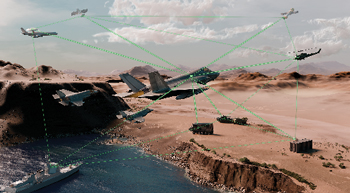
Figure 2 Example of an EW system in action, including ground, air and sea.
Cognitive capability is becoming a defining feature of next-generation aerospace systems. Electromagnetic spectrum operation platforms, including those that are ESA-based, can now learn from environmental conditions, optimize their transmit chains and adapt waveforms to mission requirements. For example, an EW system might use machine learning to classify emitters and choose jamming techniques in real time. Figure 2 shows an artist’s rendition of an EW system in action.
Validating these systems requires more than performance measurements. Engineers must assess behavior under varying inputs, determine whether learning is occurring as intended and verify that adaptations do not degrade mission-critical functionality. This demands repeated testing in diverse scenarios using RF emulation, signal synthesis and behavior logging.
Test strategies must evolve to treat cognitive systems more like dynamic decision-makers than static signal chains. Measurement platforms should support traceability, closed-loop analysis and the ability to replay and modify mission scenarios. Just as human pilots must be trained and reassessed under stress conditions, cognitive ESA systems must be evaluated continuously under varied and unpredictable RF environments.
HYPERSONICS AND THE NEED FOR HIGH SPEED AGILITY
Lastly, the rapid emergence of hypersonic platforms poses a unique challenge to radar and tracking systems. These vehicles travel faster than Mach 5, often exceeding Mach 10, with extreme maneuverability and very low radar cross sections. Doppler shifts at these speeds can exceed 30 MHz, requiring radar systems with wide instantaneous bandwidth, high update rates and rapid reconfiguration.
To meet these requirements, ESA radar systems are adopting wideband, multichannel architectures and integrating GaN amplifiers for greater output power and efficiency. However, GaN devices demand highly accurate testing due to their nonlinear behavior, high power density and sensitivity to thermal and electrical stress.
To test and validate these systems, simulated environments using FPGA-based radar emulation, wideband signal generation and synchronized measurement systems provide an effective alternative to expensive live-fire testing. These setups allow engineers to validate waveform design, beam agility and system response to high speed targets under repeatable and cost-effective conditions with flexibility that allows for ever-changing test requirements.
AEROSPACE READINESS THROUGH ADVANCED TESTING
ESA systems in aerospace applications are becoming more compact, intelligent and multifunctional. They are also more difficult to characterize due to integrated digital interfaces, cognitive features and demanding mission profiles. Success requires a new test philosophy based on flexibility, coordination and realism.
PXI instrumentation provides the modularity and performance required to meet these challenges. By supporting both device-level validation and system-level emulation, PXI-based platforms help accelerate development cycles, reduce integration risk and ensure mission readiness.
Aerospace innovation will increasingly be defined by the ability to adapt across frequency domains, functional modes and operating environments. ESA systems are enabling that adaptability. With the right test strategies, engineers can unlock their full potential and keep pace with the evolving demands of aerospace technology.
Emerson
Austin, Texas
www.ni.com