

Hybrid RF-over-Fiber (RFoF) communication systems are emerging as promising interference-resistant solutions in the military and aerospace industry. Their capability to transmit RF signals over long distances with minimal loss makes them suitable for both ground-based and aerospace applications, including UAVs and fighter aircraft such as F-15s. Trends driving this adoption include the demand for rugged designs, the need for futureproofing, the increased importance of cost efficiency and the desire for EMI immunity.
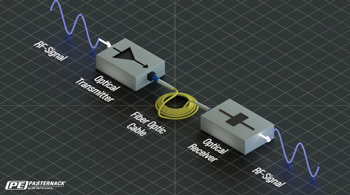
Figure 1 Example of an RFoF system.
This approach merges the capabilities of RF and fiber technologies by converting RF signals into optical signals for transmission, then back to RF at the destination, as shown in Figure 1. The use of fiber allows for a cleaner signal that travels further with better protection. This hybrid system mitigates and balances any technical concerns and challenges inherent to standalone RF or fiber systems, including signal jamming and interception.
BENEFITS OF HYBRID RFOF ASSEMBLIES
Hybrid RFoF systems provide long-reach, low loss and EMI immune RF transport across commercial, industrial, aerospace and military defense applications. By transmitting RF signals optically, these systems experience lower attenuation across longer distances, for example, greater than 20 km with fiber versus 30 meters with RF coax, while offering larger bandwidth for high speed communication across mission critical platforms. This allows sensitive RF equipment to be placed in controlled environments, while antennas and sensors operate remotely.
Fiber-optic cable offers a lightweight solution to traditional copper cabling, addressing the space and weight limitations encountered in aerospace systems. Additionally, when impacted by long distances, RF coaxial cables can experience signal loss that requires occasional amplification by adding additional components. Hybrid RFoF systems carry a clean RF signal further with better protection and a lower level of signal loss, which in turn saves space. RFoF isolates the signal from the environmental stressors that normally affect electrical cables, such as EMI, RF interference (RFI), ground loops or lightning-induced surges.
Military and aerospace vehicles often maneuver through rough terrain and strong winds with high vibrations and extreme temperatures. Signal integrity and latency are important to ensure safe operation and landings, making ruggedized components essential for these environments.
RF VS. FIBER VS. HYBRID BENEFITS
With military and aerospace systems demanding both signal and power transmission, there are some important differences between hybrid RFoF, legacy RF and fiber-optic cabling approaches, depending on the needs of a project.
RF cables are best used with short-range links, such as connecting antennas to radios in base stations. Legacy RF systems are beneficial where existing infrastructure is based on coaxial cabling. Additionally, RF cable assemblies are useful for applications where signal and DC power are transmitted together, like voice over internet protocol (VoIP) phones and security cameras.
Fiber-optic cables are useful for long-haul communications such as telecom backbones, submarine links, satellite and UAV ground stations. High speed digital systems benefit from fiber with 5G front haul as well as high frequency trading networks. Weight and space constraints are improved from the fiber’s lightweight construction for aircraft and satellite applications. Fiber also assists with futureproofing, enabling higher frequency and increased bandwidth over longer distances.
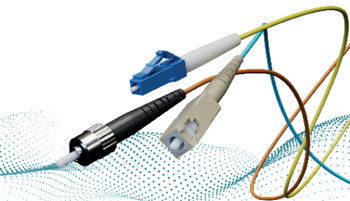
Figure 2 Examples of RFoF cables.
Hybrid RFoF systems merge the low loss, EMI immune advantages of fiber with the convenience of integrated power delivery by converting the RF into an optical signal for long distance transmission, then converting the signal back to RF. The benefits of RF and fiber are combined, allowing futureproofing, reduced maintenance and minimal signal loss. Fiber-optic cable assemblies are now the standard choice for telecom, defense radar/communications, broadcast uplinks and industrial automation. Figure 2 shows examples of these cables.
MOVING FORWARD
Military and aerospace applications expect precision and reliability from their communication systems. RFoF is still navigating a slower adoption curve in the industry, but continued advancements are likely to help the next generation future-proof these systems for success. Data demand, bandwidth requirements, latency, interference management, optical component advancements and more will continue to push military and aerospace toward adopting new technologies for innovative solutions. Fiber cables have continued to evolve in speed and versatility, creating additional opportunities to increase operational efficiency.
Other potential avenues for RFoF technology can include integration with edge computing, integrated sensing and communication and multi-channel wavelength multiplexing, not to mention increased capabilities to handle security, resilience and redundancy demands. For optimal support, training and education can help move the industry forward, ensuring all parties are aware of challenges and solutions that will help overcome technical barriers for success.
Pasternack
Irvine, Calif.
www.pasternack.com