


Figure 1 TH-112 tunable harmonic switched filter bank (3.3 x 2.5 x 0.72 in.).
Modern communication systems often need compact high-power filters to reject amplifier harmonic signals. Traditional fixed filter banks are large and bulky, as they frequently rely on multiple fixed filters and switches to cover the entire frequency range, which adds to the size and complexity. Tri-TeQ’s patented tunable harmonic switched filter banks (THSFBs) address these issues by reducing the number of filters and switches through tunability. Power handling and performance are maintained while the unit footprint is reduced to less than a quarter the size of related products.
Tri-TeQ offers 10 W, 20 W, 50 W, 100 W and 125 W THSFBs, all of which feature proprietary techniques for power handling and size reduction. Tri-TeQ’s flagship TH-112 unit, shown in Figure 1, features 100 W CW power handling with 10 harmonic filter bands, in a package size that is 75 percent smaller than competing designs with similar power handling and electrical performance. A typical application for this THSFB is filtering transmit harmonics of the final power amplifier (PA) stage in broadband multi-octave military hopping radios.
MINIATURIZATION TECHNIQUES
The basis of the harmonic switched filter bank (HSFB) is a lowpass filter. The lowpass filter passes the fundamental frequency and rejects all the harmonic signals at a frequency of an octave and higher. If the PA operates over a multi-octave frequency range, then multiple lowpass filters will be required. The filters switch between each band corresponding to the frequency at which the PA is functioning.
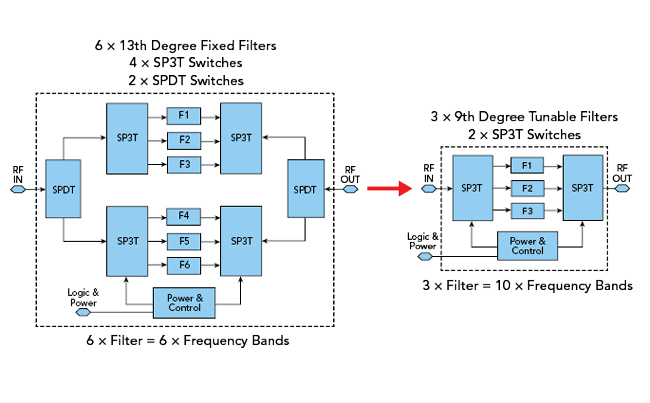
Figure 2 Simplified depiction of size reduction implementation.
Most traditional HSFBs use single-pole multiple-throw (SPnT) switches at the input and output of the unit. Often, they have at minimum a single-pole 6-way switch for a 30 to 512 MHz coverage, with a high-power lowpass filter in each of the six arms of the switch, as demonstrated in Figure 2. These units are enclosed within a housing with heat sinks. Tri-TeQ’s THSFB offers a reduced number of switches and filters by making each filter tunable. By reducing the number of filters from six to three, the three tunable filters are formed to create 10 bands. Fewer switches and filters make the filter topology simpler. Additionally, by having 10 bands rather than six, the selectivity required from each filter is reduced from 15 percent typical to 45 percent, allowing for lower-order filters, reducing the insertion loss (IL), particularly at the passband edge, shown in Figure 3. A reduction in IL also leads to decreased power dissipation, which minimizes thermal challenges and eliminates the need for extensive heat sinking, further reducing size. The TH-112 has a greater than 75 percent reduction in footprint and a larger reduction in volume when compared to current parts of the same class, without sacrificing harmonic rejection and with improved IL (see Table 1). Additionally, THSFBs require fewer control lines and control schemes, making integration and operation easier.
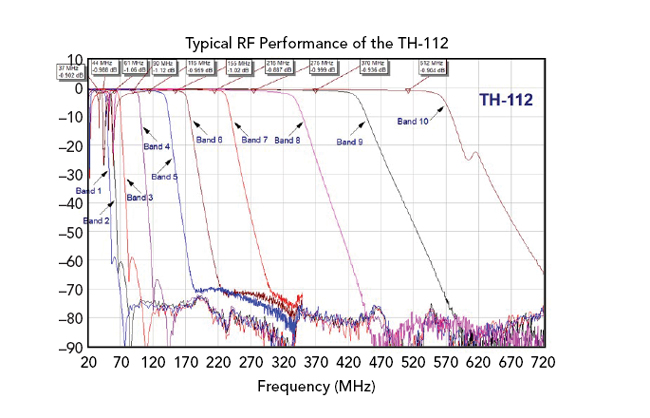
Figure 3 Typical TH-112 performance.

Reducing switches and using lower degree filters significantly decreases the bill of materials. Fewer and lower degree filters also reduce the build and tune time, equating to reduced hours spent working on the unit, all of which enables a reduction in the unit cost and lead time, while still enabling improved reliability and consistency over traditional methods.
TH-112 FILTER PERFORMANCE AND THSFB ADVANTAGES
The technology employed within the current range of Tri-TeQ’s THSFBs can be adapted to other frequency ranges and numbers of bands for user-specific applications. The current units with power handling of 50 W or below are available in either SMA or surface-mount packages.
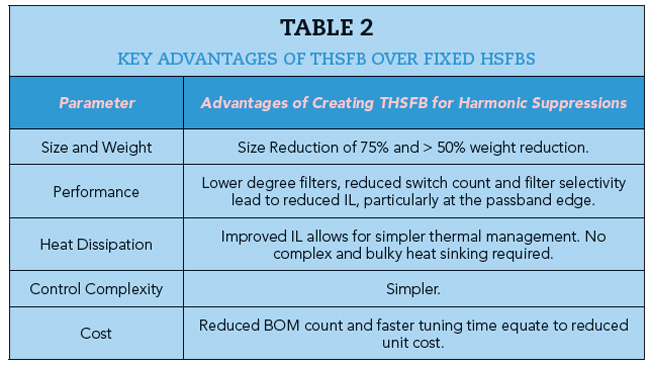
Converting a traditional HSFB into a tunable form reduces unit size, complexity and cost, while enhancing performance (see Table 2). Tri-TeQ welcomes any questions regarding the products highlighted, as well as collaboration and inquiries for custom adaptations of these THSFBs.
Visit www.tri-teq.com or contact info@tri-teq.com for more information.
Tri-TeQ
Framingham, Mass.
www.Tri-Teq.com