

Historically, engineers procured CAD software with the implicit understanding that their hardware design process must conform to how a given software tool works. Vendors define their user interface and functionality, hoping to cover as much of the design process as possible. Engineering teams have a variety of tasks in their workflow and find or create tools for those tasks. Switching any tool in the suite usually means changing the steps required to complete a task, and sometimes the entire design workflow.
As hardware evolved in complexity, designers started to need multiple software tools to complete all the tasks in their workflow. Customers often settle on combinations of vendor and homegrown tools fitting their specific EDA needs, increasing the difficulty of adding or switching tools. Industry interoperability initiatives such as Si2 with OpenAccess implementations for EDA data repositories and APIs made tighter vendor-supplied integration and better growth paths feasible. Still, integrating RF simulators into modern workflows remains challenging, prompting a solution.
Keysight researchers are imagining a different direction for an all-new RF simulator suited for complex high frequency RF design, retaining integration benefits with a new programmatically-controlled, extensible platform. This research deepens the ties between measurement and simulation technology. Keysight explores the motives for developing a next-generation RF simulator, how designer productivity is shifting with help from research insights and the possibilities this simulator offers in automated RF design workflows, including roles for AI.
MOTIVES FOR PROGRAMMATICALLY CONTROLLED RF SIMULATION
Software development teams seek to combine and prioritize customer needs and align them with research and development knowledge, a product’s inner implementation secrets and the resources needed to effect changes. If a software tool finds widespread adoption, it becomes difficult to simultaneously morph into different design spaces while maintaining a state-of-the-art core engine. Technological expansion may suggest advanced capabilities, but required engine modifications limit or preclude adding them without substantial risk or costs. At some point, breaking with the past and creating an all-new engine architecture and code base becomes a better option for developers and users, similar to how buying a new computer can be more cost-effective than upgrading.
An RF simulator, the engine driving any modern RF EDA workflow, is no exception. Keysight’s RF simulation technology evolves in lockstep with its measurement science. That philosophy helped Advanced Design System (ADS) become a key platform for complex RF design with extensive circuit electromagnetic (EM) co-simulation capability.
Still, more is possible. Reimagining the possibilities for next-generation simulation in RF EDA began with the realization that Keysight’s previous RF simulator engine is sophisticated but traps an immense amount of information behind its interface, rendering it inaccessible. Keysight researchers, inspired by measurement workflows, asked what might be possible by re-architecting a streamlined RF simulator, creating more hooks for programmatic execution control, leveraging interstitial data and matching features to real-world engineering design processes. In this light, a simulation engine becomes more like a measurement instrument: portable, automatable and pluggable into many different workflows. This curiosity reveals several motives for a high-stakes project.
- Modernizing the user interface and uncluttering schematics: User interface design directly affects user perceptions of ease of use. Powerful tools would start simulations directly from the schematic interface and avoid the creation of spin-off schematics to handle specific simulations. Layout versus schematic (LVS) verification could be more straightforward; the previous RF simulator inserts simulator controllers, probes (see Figure 1) and other info on a schematic, requiring stripping that information back out for error-free verification.
- Providing methods to control user interfaces and simulation invocation: Python scripts calling an API are a popular addition to the previous simulator. Still, more opportunities exist to expand and customize user interfaces and introduce standard Python analysis functions. There is also the possibility for command-stream invocation of simulations, even bypassing the simulator user interface (headless), with calls issued by ADS or other workflow tools.
- Separating simulation analysis from workflow tasks and speeding up analyses: Semantics aside, simulation has two distinct steps: picking an analysis, like S-parameters, envelope or harmonic balance, and setting up a task, which is a sequence of analyses, like sweeps or optimization. In short, an analysis defines behavior evaluation, and tasks control how analyses execute (see Figure 2). Once that distinction is made, more efficient parallelization and significant speed-ups become possible.
- Pre-processing for defining sweeps, optimization and visualization: Fine-grained parameter control of simulations via a user interface is necessary, but is not enough to make simulations more efficient. Users commonly apply post-processing for data display to extract and visualize subsets of data (for instance, zooming in on a range of frequencies), yet the simulation runs across the entire data set. Pre-processing could define reusable expressions evaluated during simulation, in analyses or tasks, with enhanced Python filtering capability for results (see Figure 3). Automatically tying simulation pre-processing to optimization and plotting could also save more steps in the workflow.
- Capturing and sharing simulation, display and optimization parameters: Control of numerous simulation parameters is a plus, but it also introduces a potential traceability issue. Reproducing simulations run yesterday, last week or last month with the exact same parameter settings can be daunting. In the measurement domain, routines embedded in instruments provide reproducible specification compliance testing. A similar approach introduces Performances, which capture settings, expressions, filters, optimizations and specifications for traceable, reusable and sharable simulations.
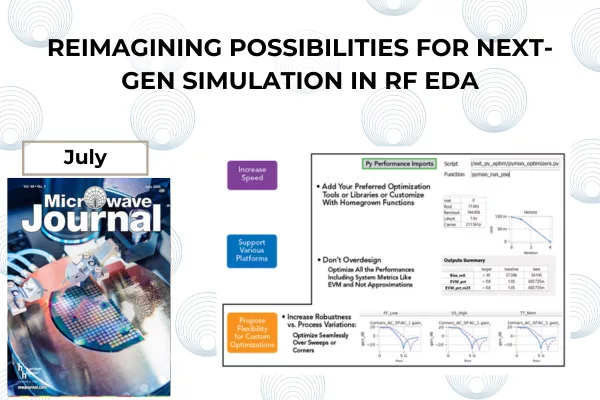
- Unlocking 10x better optimization speed with parallelization: Although good algorithms exist in the previous RF simulator, optimization remains challenging as frequencies rise, heterogeneous technologies integrate and specifications tighten. A significant hurdle is shifting from individually optimized subsystems to larger problems in the global optimization of an entire design. An example is band filters, with perhaps ten or more working together, and leakage from one band can affect the performance of others. Another could be optimizing on different corners to find values to minimize the impact of process impairments. Joint optimization increases the domain space and the multi-dimensional surface for optimization. It is also possible that, in a heterogeneous scenario, individual subsystems come from different design platforms, making global optimization more difficult. New algorithms and multi-threaded parallel execution could boost execution speed by an order of magnitude.
- Setting up flexible licensing for immediate team access to features as introduced: Licensing has also held back simulation users in some situations. An industry trend recognizes different lifecycles. Teams desire more stable design platforms with updates once, twice or maybe three times a year. RF designers tend to want on-demand simulator updates within weeks or even days of fix and feature releases. A modular simulator that can update without changing the underlying platform solves some issues. Flexible licensing that allows using any simulator feature without relicensing, including the latest feature releases, would be an improvement as design workflows morph.

Figure 1 Schematics of (a) a Winslow probe inserted directly versus (b) virtual insertion via the user interface.

Figure 2 Separation between analyses and tasks in the simulator user interface.

Figure 3 (a) Expressions evaluated during analyses in simulations, and (b) Python filters on curves in displayed results.
Of course, these motives coexist with ongoing efforts to add and enhance simulator analysis types and improve their raw execution speed. For instance, work continues on gain compression enhancements and a revamped memory model for effects on high bandwidth signals. The primary mission of the RF simulator remains to deliver accuracy but not sacrifice time. Addressing these motives for programmatic control unlocks another level in workflow productivity while enabling intense analysis of complex RF designs.