

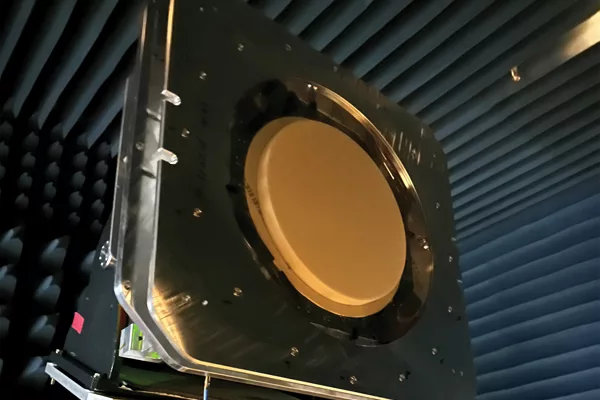
In a world-first, Kymeta, the company reimagining satellite connectivity, announces a major technological leap: simultaneously operating across both Ku and Ka satellite bands in a single, compact antenna - laying the technical groundwork to enable seamless connectivity across satellite networks.
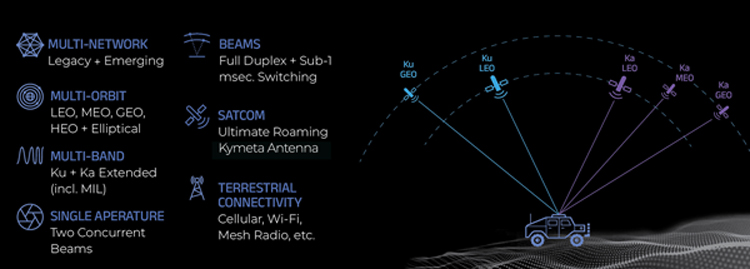
This breakthrough marks a significant milestone for the satellite communications industry, ending a legacy of siloed satcom limitations. Kymeta has now advanced the ability to interoperate across satellite networks in different bands and different orbits, in a move to make satellite as seamless and ubiquitous as cellular.
Bruno Fromont, Intelsat CTO said: “Transformative technology milestones like this spark a catalytic shift across an entire landscape. Kymeta’s ability to unify Ku- and Ka- band connections through a single mobile antenna is a foundational leap toward combined satellite networks, making communication as seamless and automatic as the cellular networks we use every day. This success is changing the game.”
The ability to connect to both Ku- and Ka-band beams offers immediate and significant benefits - unlocking higher bandwidth, faster data rates, and more bits per second (bps). This also enables continuous connectivity, a vital component toward making advanced AI at the edge a reality. The breakthrough will now allow manufacturers to build the advanced tech of the future where this is a requirement.
This achievement meets the demands of global militaries. The US Space Force vision whitepaper in 2020 outlined the requirement to support multi-bands, orbits, waveforms and a “network of networks to support responsive and agile operations”. Along with traditional C2 (command and control) functions, autonomous applications such as unmanned surface and aerial vehicles (USV, UAV and UGVs) require strong, reliable connectivity to operate and be competitive on the battlefield. This serves as a network hub and backhaul for downstream communication using MANET, mesh and cellular networks that will enable autonomous system operations at scale.
 Silhouettes of soldiers are using drone for scouting during military operation against the backdrop of a sunset. Application of modern technology during war | Getty Images
General (ret) Paul J Kern, former Commanding General, Army Materiel Command, currently Senior Counselor, The Cohen Group comments: “Kymeta’s breakthrough in seamless switching between Ku and Ka satellite bands delivers the kind of resilient, always-on communications that advanced military platforms and autonomous systems demand. This is a major step forward in preparing and equipping our forces for the modern battlefield. This capability would have made an enormous difference to my operations in the desert of Iraq.”
Relying on a single network connection is insufficient to meet the complex and evolving needs of modern global forces, making multi-band beam switching a strategic necessity. This capability allows for simultaneous and redundant communication links, which are critical for maintaining operational integrity in contested or jamming-prone environments while on the move.
 Battlefield with a soldier, armored vehicle and flying helicopters at sunset | Getty Images
Ian Canning, president and CEO of Eutelsat America Corp + OneWeb Technologies (EACOWT) comments: “The U.S. DOD and defense forces around the globe require increasingly sophisticated, flexible and secure communications, which includes the need for high-performance, multi-band connectivity from a single antenna. Kymeta’s continued investment in innovation using their unique metamaterials approach is truly disruptive and will open the door to the resilient communications required in the modern battlefield. Their innovation into an ESA platform, brings multi-orbit and multi-band capabilities into the modern era. I look forward to collaborating with Kymeta on developing world class products for the satellite communication industry.”
The technology was successfully demonstrated and validated at Kymeta on April 22, 2025. This achievement was made possible by Kymeta’s unique metamaterials antenna surface. Until this point, interoperability in the Ku- and Ka-Bands has been possible only with Electronic Steered Antennas (ESA) using multiple physically separate antennas, which proves problematic due to the size and power usage required to operate. This technological disruption by Kymeta allows connectivity in both bands in one single antenna, giving space efficiency, low power consumption, and low cost (SWaP-C).
Kymeta Chief Scientist, Ryan Stevenson, says: "At Kymeta we’ve never followed convention. What began as novel metamaterials technology is now a proven engineering foundation - first brought to market in 2017, and now central to this groundbreaking achievement. We've turned breakthrough physics into a powerful, trusted toolkit. Using this toolkit we have now addressed the most challenging requirement in satellite communications. We have cracked the code on seamless multi-orbit, multi-band connectivity - and have set the standard for next-generation satellite communications.”
How it works
The physical area of Kymeta’s multi-band antenna aperture consisting of four, interleaved sub-arrays – Ku- transmit, Ku- receive, Ka- transmit and Ka-Band receive – allows for simultaneous and independently controlled Ku- and Ka-Band full duplex beams from its metamaterials surface. Structuring the antenna in this way, and pairing it with advanced AI algorithms for intelligent routing, enables frequency reuse and alleviates spectrum contention via Kymeta’s narrower receive and transmit beams. These beams are more focused and operate at higher directivity, promoting spectrum efficiency and interference mitigation, such as GEO / LEO beam straying, jamming and adverse weather like rain fade and atmospheric losses.
Further Innovation / Funding
With the success of this innovative advancement, fueled by the company’s VC support and Silicon Valley spirit, Kymeta looks towards its next phase of growth and will be working with strategic investment partners, as well as key government programs, who share the company’s vision to scale this universal transformation.
To find out more, visit www.kymetacorp.com.
--------------------------------------------------------------------
We talked with Kymeta and the test was done in an analog chamber where Kymeta was able to demonstrate beam patterns simultaneously operating across four distinct bands, Ku receive, Ku transmit, and then the Ka receive and Ka transmit SATCOM bands. They demonstrated the full beam control over each of those beams individually, pointing them to different angles and different polarizations.
The duplex operation has been characteristic of the technology since the first product because it interleaves the bands and signal in the meta surface. With the approach, they can interleave these different sub arrays into one physical aperture. But the way that they implement the manufacturing technology, leveraging the display industry, Kymeta drives the array on an active matrix backplane. Very similar to how, in their first and second generations used liquid crystal television, they are migrating to a solid state diode tuning approach - very similar to how a mini LED or a micro LED display works, and they are able to individually address and control the receive arrays or the sub arrays completely independently. That runs on on a refresh cycle, the same way a display works. Every 400 microseconds, they can update the whole array and change the angle of each of those beams independently.
The beam forming works based off of the principle of holographic diffraction. They are defining a unique surface impedance that interacts with the feed wave to scatter that feed wave and produce a beam in a certain direction. And because they have individual control over the different sub arrays, they can define those impedances differently for each of the sub arrays. And so effectively, they are using the diodes to tune the capacitive reactants of each of the antenna elements in the array and effectuate that change in surface impedance.
This is a very different approach than other beamsteering arrays that use phased array technology. In a phased array approach, you would have to have 4 different arrays, one each for transmit and receive for each frequency band, making the surface much larger and heavier.
This gives Kymeta's approach a huge directivity advantage over the phased array approach and even some of the more recent wide band phased array approaches that have been published in the literature, they're still having to separate, receive and transmit because of those, those active transmitters in the sensitive LNAs that are, that are in those phased arrays, they're not able to share the aperture.
In that sense, they have to physically separate receive and transmit, and often times include transmit reject filtering on the receive side to prevent self-interference from the transmit array. And so, what Kymeta is able to do then, in a typical footprint, is have a beam width that's about half the beam width of a similar phased array approach. And so, from a directivity perspective, that gives them a narrower beam if you look at it from an interference environment. On the receive side, the significance of that is, it's going to make the Kymeta array a lot more resistant to interference or even intentional jamming.
If you look at where an interfere might fall on the phased arrays main beam, it's more typically going to be falling more into the null well off of Kymeta's main beam. So in some scenarios that we've analyzed, Kymeta would have 100x better interference rejection, and 20 dB better interference rejection, simply due to the better spatial filtering that you get from a higher directivity beam. And then on the transmit side, they are also radiating energy into a much smaller cone so it makes us less detectable.
In the sense of why MODs and DODs, are concerned about this kind of thing, it makes these arrays less detectable. You have a lower signature when you're transmitting through a higher directivity antenna. But even in the commercial sense, it assists with frequency re-use and frequency sharing. And as space gets more congested, as more LEO constellations go up, having a higher directivity beam enables frequency reuse, and it can help resolve some of the spectrum contention issues that are going to occur.
And size wise, what Kymeta sees is the phased arrays can typically be a little bit narrower in one dimension, but sometimes longer in the other dimension than us. For example, the Osprey product, what Kymeta calls the U8 antenna, the package is about 90 by 90 centimeters – and that's what's currently used in their military facing product right now. The Osprey has the interleave transmit/receive capability so if you're going to combine Ka-Band, transmit and receive, Kymeta can do that in the same footprint. For a phased array, they would have to add two more phased arrays into that, so from a footprint perspective, you'd expect the phased array solution to have to double its footprint, while Kymeta can maintain the same footprint. From power perspective; it's going to become even wider when you think about adding the multiband component.
For the future, Kymeta has another approach that would then enable on each band, two simultaneous beams, two full duplex beams in the Ku-Band and two in the Ka-Band. It requires some re-engineering of the overall feeding architecture that feeds the meta surface, but that's something that's next up on their roadmap.