


Figure 1 TR-2900 weather radar system.
Providing early warning for extreme weather has become an increasingly important requirement for weather radar systems as populations have become larger and denser. A recent report from the International Chamber of Commerce1 predicts that extreme weather events will cost the global economy more than $2 trillion over the next decade. When the loss of life is added to the economic impacts, the need for more powerful and sophisticated weather radar systems becomes apparent.
Since the early 1970s, Pulse Systems has been a globally recognized leader in the development, design and manufacture of magnetic components, radar subsystems and RF sources. These reliable, high-quality, high performance products range from solid-state and tube-based transmitters to power supplies for a variety of radar-based applications in defense and industrial markets. To support the evolving needs of the weather radar market, Pulse Systems has released the TR-2900. The complete weather radar system is shown in Figure 1.
As shown in Figure 1, the TR-2900 weather radar system is large and complex. It consists of a high-voltage power supply, a control panel and a pulse modulator system comprised of circuitry and RF driver stages powering a CPI magnetron as an output stage. The magnetron provides a minimum of 250 kW of peak power at the output flange from 5.2 to 5.9 GHz. The system is designed to be connected directly to an antenna as a single polarization system. It can be configured for dual-polarization applications by incorporating some additional microwave components. Figure 2 shows an assembly drawing of the mechanical considerations along with these electrical functions.

Figure 2 Mechanical assembly drawing showing electrical functions.
Conventional weather radar systems use a line-type modulator system, where the pulse width is determined by the characteristics of the system’s pulse-forming network. This approach creates tuning challenges for the user. To mitigate this issue, the Pulse Systems TR-2900 has been designed with a programmable logic controller (PLC) to provide variable pulse widths. The pulse width of this system can be set anywhere from 0.5 to 2.0 μsec with a 0.1 percent (0.001) duty cycle. An Allen Bradley integrated PLC with pre-selectable pulse widths at 0.5 μsec, 0.8 μsec, 1.0 μsec and 2.0 μsec allows for the variable pulse width capability.
The complete modulator system consists of a supervisory control circuit governing the operating conditions of the two drive circuits and the output section. The output section consists of a solid-state switch assembly, a high-voltage step-up pulse transformer, a DC filament power supply and a pulse-shaping network. To generate the narrow pulses that weather radar applications may require, the rise and fall times of the RF signal must be short. Achieving the necessary pulse rise and fall times places stringent considerations on the magnetic material that is used in the pulse transformer design and the proper winding configuration. These are two areas that benefit from Pulse Systems’ long heritage and expertise in magnetic material and components.
Pulse Systems’ heritage and expertise also come into play with the magnetron-based output stage. To prevent magnetron modding, the rate of change for the cathode voltage must be controlled. We have determined that the cathode voltage rate of change must be kept in the 60 to 70 kV/μsec range. The high-voltage section of the modulator, including the pulsed-voltage control of the magnetron cathode, is in an oil-filled section of the weather radar system. The control function for the modulator includes a solid-state switch assembly mounted on a heat sink for easy access. This switch assembly is turned on during the positive portion of the drive pulse and kept off when the drive pulse goes to a negative bias level. The high-power switching capability of these devices and their high efficiency make them well-suited for weather radar systems. The output pulse width of the system bears a close relationship to the drive pulse of the switch driver.
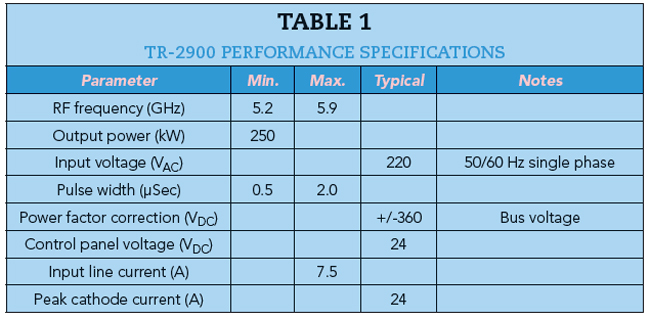

Figure 3 TR-2900 output power.
The power supply for the system is also an important design consideration. In this case, the high-voltage power supply has a series resonance full-bridge configuration that uses SiC FETs as the main switching elements. This power supply configuration operates at an 80 KHz clock frequency with a pulse width modulation regulation scheme. Some representative performance characteristics of the TR-2900 weather radar system are shown in Table 1.
Figure 3 shows the output power of the TR-2900 weather radar transmitter. To safely accommodate the power levels, the output signal has been attenuated by 40 dB. The trace shows the output power at a center frequency of approximately 5.586 GHz with a 2.0 μsec pulse width.
With a long heritage and history designing transmitters for radar applications, Pulse Systems has introduced the TR-2900 weather radar system. This system incorporates solid-state technology, in addition to magnetron technology, to address some of the challenges created by previous solutions in the segment. The result is a high performance, high-power system that supports the evolution of weather radar system capabilities.
Reference
- “New report: extreme weather events cost economy $2 trillion over the last decade,” International Chamber of Commerce, Nov. 11, 2024, Web: “https://iccwbo.org/news-pA recentublications/policies-reports/new-report-extreme-weather-events-cost-economy-2-trillion-over-the-last-decade.”
Pulse Systems
Easton, Mass.
pulsesystem.com