

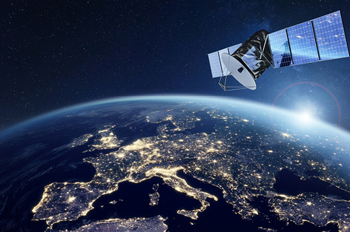
Figure 1 Satellite in orbit.
Market projections indicate that by 2030, over 60,000 satellites could be operational in low Earth orbit (LEO), a significant increase from the approximately 8000 in orbit today.1 This surge in activity is defining how companies approach component sourcing, manufacturing and system integration. This article describes some thoughts about how companies can enter this “New Space” market and find the right suppliers for their mission-critical systems. Figure 1 shows an artist’s conception of a satellite orbiting over Europe.
LEO AND GEO REQUIREMENTS
Traditionally, geostationary orbit (GEO) satellites have dominated space-based communications. Operating at approximately 35,786 km above the equator, GEO satellites maintain a fixed position relative to the Earth’s surface, providing consistent coverage over specific areas. Due to their high altitude and extended operational lifespans, ranging from 15 to 30 years, GEO satellites require components with exceptional reliability, often backed up by redundant systems. The high costs associated with launching and maintaining these satellites necessitate the use of tried-and-tested technologies with extensive heritage.
In contrast, LEO satellites orbit at altitudes between 200 and 2000 km, resulting in shorter orbital periods and the need for larger constellations to ensure continuous coverage. This proximity to Earth reduces signal latency, benefiting applications like real-time communications and Earth observation. However, the shorter lifespan of LEO satellites, often between five to 10 years, combined with the scale of deployments that often involve thousands of satellites, demand a different approach to component sourcing.
COTS COMPONENTS
For companies stepping into the LEO sector, the traditional approach to satellite component sourcing no longer applies. In the GEO market, reliability has always been the top priority, with space-grade components rigorously tested and used in nearly identical applications for years. GEO satellites are incredibly expensive to launch, so redundancy is built into the systems, ensuring each satellite can function flawlessly for as long as possible. LEO satellites, on the other hand, operate on a different cost model. The shorter lifespans and higher replacement rates mean companies must strike a balance between quality and affordability while maintaining the ability to scale production rapidly.
One of the biggest game-changers in this new era of satellite technology is the increasing reliance on commercial off-the-shelf (COTS) components. The industry is recognizing that shorter mission lifetimes can be achieved without needing parts screened to exceptionally high quality levels. This means that high performance components originally developed for industries like telecommunications and defense can offer suitable alternatives.
These sectors demand reliability at scale, making them a natural fit for the LEO market. Using COTS components allows satellite manufacturers to significantly reduce costs, shorten lead times and incorporate the latest technological advancements without the years-long development cycles associated with traditional space hardware. That being said, not all commercially available components are ready for space. Satellites endure extreme conditions, including intense radiation, temperature fluctuations and the vacuum of space. This means that while COTS components offer cost and scalability advantages, they must still be tested and, in many cases, adapted to survive in orbit. Companies looking to source complex assemblies for LEO need to work with suppliers who have experience in both volume manufacturing and space qualification processes.
COLLABORATION AND COMPETITIVENESS
The key to success in the space industry lies in finding partners who understand how to adapt commercial components for space applications without inflating costs to traditional space-industry levels. The European Space Agency has recognized this challenge and is actively investing in programs that support the commercialization of space technology. An example of this is a recent success story at Filtronic, which secured a €3.7 million contract under the ARTES program to develop advanced mmWave products for satellite payloads and gateway links. These products, essential for high frequency bands like Ka-, Q-/V- and W-Band, are crucial for enabling faster, higher-capacity data transfer between space and ground stations that are key to next-generation satellite communications. This win allows Filtronic to build on its 40 years of RF expertise and expand its technologies into the LEO market, further strengthening Europe’s competitive edge in the rapidly evolving satellite sector.
As the LEO sector matures, competition among satellite operators is only intensifying. SpaceX’s Starlink constellation has set the benchmark for large-scale deployment, but other operators are quickly advancing their own networks. The merger of Eutelsat and OneWeb, in particular, is a significant development that strengthens Europe’s position in satellite broadband, providing a viable alternative to U.S.-led systems. In regions where geopolitical tensions complicate reliance on certain satellite networks, having diverse providers is crucial to ensuring global connectivity.
AGILITY
For suppliers and manufacturers, agility has become one of the most important factors in remaining competitive. The ability to rapidly iterate designs, respond to shifting market demands and produce components at scale without compromising on reliability is now just as important as technological innovation itself. Traditional space-industry timelines, where new technologies could take a decade to develop and launch, are no longer viable in the fast-moving LEO market. Instead, companies that can quickly adapt and scale up production will be the ones driving the next generation of satellite communications. As LEO satellite networks scale, higher frequencies are becoming essential for meeting the growing demand for data capacity. Operators are increasingly pushing beyond Ka- and Q-/V-Bands into bands that operate up to and above 100 GHz. However, these higher frequencies introduce new engineering challenges.
THE CHALLENGES
One of the main issues is signal attenuation, which becomes more severe as frequency increases. Atmospheric absorption, particularly due to oxygen and water vapor, is much more pronounced at these frequencies, meaning signals weaken over shorter distances. This requires sophisticated techniques to compensate for signal degradation, such as adaptive power control, beamforming and advanced error correction methods.
Another challenge is the precision required in component manufacturing. As frequencies increase, the tolerances for RF components become much tighter. Even the slightest imperfections in antennas, for instance, can cause significant signal loss or distortion, meaning that manufacturing processes must be incredibly precise, often requiring advanced materials and fabrication techniques to ensure performance consistency.
Heat management is also a critical issue. At higher frequencies, power amplifiers and other active components generate more heat and efficient thermal dissipation becomes essential to prevent performance degradation. In space, where there is no natural convection to dissipate heat, engineers must design innovative cooling solutions, like heat spreaders and radiative cooling systems, to manage thermal loads effectively.
Ultimately, success in the New Space market depends on striking the right balance between performance, cost and scalability. Companies sourcing components for LEO need to think beyond the traditional space-industry playbook and instead look for partners who understand both the commercial and technical challenges of mass-producing high-reliability components. The days of building one-off, ultra-expensive satellites are fading. In their place, a new approach that values flexibility, efficiency and innovation is dictating the route that space technology takes.
References
- “The Future Space Environment,” GOV.UK, May 2024, Web: www.gov.uk/government/news/the-future-space-environment.