


Microwave radios have long been a key component in transporting mobile backhaul traffic between towers and the central office. As wireless networks evolve, microwave radio development becomes a crucial enabler. Advancements in energy efficiency, traffic management and capacity thresholds are collectively moving the market forward to meet the requirements of advanced 5G and 6G networks.
Energy Efficiency: A Gold Standard
Energy efficiency is a key metric for mobile networks, as energy sources are only expected to be further strained. According to research by Morgan Stanley,1 energy requirements for generative AI could grow by 70 percent each year. By 2027, the energy consumption of generative AI alone could match Spain’s total energy usage in 2022. According to the Energy Information Administration’s International Energy Outlook,2 global energy consumption could increase by 34 percent between 2022 and 2050. It is statistics like these, as well as increasing energy costs, that make energy efficiency important in the minds of customers like mobile operators, enterprises and government agencies.
Microwave radios are making great strides in energy efficiency by integrating generative AI into their offerings. Although creating generative AI models is initially energy-intensive, it is hoped that the energy savings achieved over time will outweigh the energy required for their development. Generative AI models have the power to transform the operation and management of microwave radios by optimizing network performance, predicting maintenance needs, enhancing energy processes and improving signal processing capabilities. These technologies enable operators to optimize resource utilization, reduce operational costs and maintain high service quality. Deep sleep mode, in particular, represents a leap forward in energy-saving potential, aligning well with industry goals of greater efficiency and sustainability.
Deep sleep mode is a power-saving feature in microwave radios designed to reduce energy use during times of reduced network demand. This capability is particularly useful in multi-carrier configurations, like 2+0 or 4+0 configurations, where full capacity is not needed 24 hours a day. Using generative AI-powered traffic-aware algorithms, the system monitors traffic patterns specific to each link. By examining past trends and current conditions, it identifies the best opportunities for activating deep sleep mode while avoiding any risk of overloading the network. This approach ensures that inactive carriers are temporarily powered down only when it is operationally safe, delivering significant energy savings without degrading service quality. Compared to standard operational states or lighter power-saving methods, AI-powered deep sleep mode offers a more substantial reduction in energy consumption, making it a valuable tool for improving network efficiency.
Ericsson’s MINI-LINK microwave radio is an interesting example of how deep sleep mode using AI can save the operator money on energy. In a case study of a medium-sized network with 5,000 2+0 links, Ericsson demonstrated that the combination of AI-powered deep sleep functionality and traffic-aware output power adjustments for multi-carrier links resulted in energy savings of 20 percent over five years, with negligible impact on user experience or service availability. This significant reduction in power consumption highlights the energy-saving potential of AI-enhanced deep sleep technology and its ability to contribute to more environmentally-friendly microwave networks. Figure 1 shows Ericsson’s energy savings using no deep sleep, fixed deep sleep and AI-powered deep sleep for the traffic-aware output power.
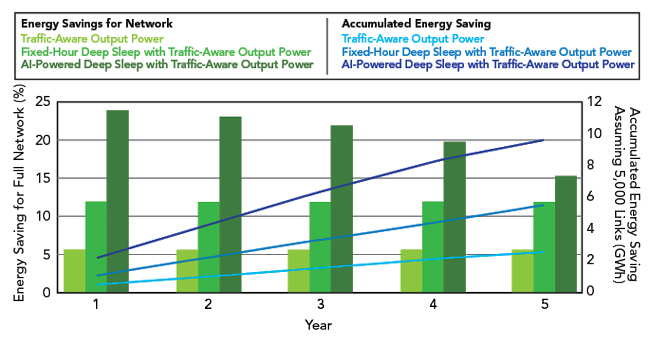
Figure 1 Ericsson energy savings for various network configurations. Source: Ericsson Microwave Outlook, 2022.
YOU CANNOT IMPROVE IT IF YOU CANNOT MEASURE IT
Predictive maintenance is another area where AI has made a significant impact by providing hardware degradation alerts and high-temperature early warnings. This allows for proactive management of potential issues, preventing costly emergency repairs and enhancing overall network efficiency. Generative AI models can also forecast network traffic growth, enabling operators to proactively optimize resource allocation and energy usage, thereby maintaining smooth network operations while preparing for future demands. Often, a technique called automated root cause analysis (RCA) is employed to help monitor and improve signal management.
One of the key applications of automated RCA is the detection and mitigation of antenna misalignment issues. By collecting and analyzing performance data at frequent intervals (i.e., every 10 seconds), link quality is assessed with high precision. This enables the detection and diagnosis of signal degradation, distinguishing between causes such as radio interference, obstructions, rainfall or alignment shifts before outages occur. These systems can determine whether immediate action is necessary or if an issue is temporary. For example, during periods of heavy rainfall, the systems can identify the weather as the probable cause of a signal drop, allowing operators to monitor the situation rather than dispatching a maintenance team unnecessarily. This targeted approach to troubleshooting and maintenance has led to significant reductions in site visits. By minimizing site visits, network efficiency improves while operational costs and energy consumption decrease. Combined with energy-saving processes like deep sleep modes and AI-based management processes, operators can enhance energy efficiency, reduce costs and reduce their carbon footprint, all while maintaining high-quality service.
An excellent example of using AI to streamline network management is Ceragon’s Insight Tool. In the last 24 months, Ceragon has reshaped its approach to network management with the integration of AI and machine learning. By leveraging AI, the platform provides comprehensive oversight of network performance, enabling operators to tackle complex challenges more effectively and use network resources more efficiently, saving them time and money. Key features of the platform include the ability to correlate alarms and incidents for faster troubleshooting, analyze link performance to detect irregularities and manage traffic predictively to anticipate capacity issues before they escalate. Additionally, the tool’s preventative monitoring capabilities enable operators to mitigate potential outages, while remote maintenance features reduce operational expenditures and enhance network performance. By addressing these critical aspects, AI-powered platforms, like Ceragon’s Insight Tool, are becoming integral to modern microwave networks. These tools help operators achieve greater efficiency and reliability in increasingly demanding environments.
THE BRASS RING: MAXIMIZING CAPACITY WITH LOW LATENCY
Besides using resources more efficiently, increased capacity is on top of mind for all operators. Advanced 5G and 6G networks use large amounts of data, which require large amounts of capacity. It is central for operators to be able to scale their existing resources to keep pace with customer demands. There are a few ways in which to increase capacity: increase the channel size, adopt higher modulation schemes (up to 16K-QAM), add another carrier or implement multi-band technology.
Multi-band technology is becoming a more common way in which operators are maximizing their links for both distance and capacity. Multi-band technology combines high capacity frequencies, like E-Band, with lower frequencies that offer higher availability and longer hop lengths, significantly boosting capacity. This approach leverages the strengths of both frequency bands to extend the reach and increase the capacity of traditional microwave links.
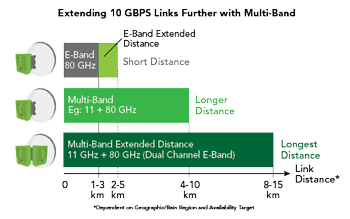
Figure 2 Link distance for Aviat 4800 options. Source: Aviat Networks.
The Aviat Networks WTM 4800 family of products is a proven example of efficient multi-band technology. By leveraging E-Band’s capacity, in parallel with one or more microwave channels, Aviat can extend the 10+ Gbps link to more than 10 km. Aviat’s 4800 product family is compelling because it offers several options, including E-Band in a single box for vendor-agnostic multi-band, multi-band in a single box and extended-distance multi-band configurations. The extended-distance multi-band configuration is a unique option, featuring two separate boxes with four channels that share a single antenna. One box contains two E-Band channels, while the other houses two microwave channels, all seamlessly integrated through the shared antenna. Other features include integrated L1-LA traffic aggregation, no requirement for an indoor unit and optimized low power consumption. By deploying radios that combine multiple frequency bands in a single unit, operators can enhance link capacity, reliability and distance without the need for additional antennas or equipment. Figure 2 shows the link distances for these options from Aviat’s 4800 product family.
Although Aviat has found success with multi-band configurations, particularly in rural areas of the U.S., Europe and the Middle East, have been using multi-band E-Band for a while. To make the best use of resources in multi-band configurations, ETSI has been working on new backhaul key performance indicators, known as backhaul traffic availability (BTA). BTA takes into account the operator’s RAN traffic statistics to minimize over-engineering of the link, ensuring efficiency without compromising the end-user experience. Multi-band, along with BTA, is just another example of how layering innovative processes can take network efficiency to another level while significantly reducing backhaul costs.
D-BAND: ANOTHER OPTION FOR ULTRA-HIGH CAPACITY
By accessing higher frequencies, operators can transmit more capacity. Just like with multi-band, traditional microwave bands add more capacity by utilizing E-Band in the 80 GHz range. D-Band is yet another frequency band that provides even more capacity by using a wide range of spectrum in an even higher frequency range of 130 to 157 GHz.
Although D-Band technology is relatively new, advancements in the technology demonstrate the ability to push past traditional benchmarks of 20 Gbps. This can be done while preserving important metrics like power, latency and efficiency. Innovations like compact, high gain antennas help make these systems even more adaptable to urban small cell networks, while the wide channel bandwidths enable faster and more efficient data transmission, enhancing deployment flexibility.
There have only been a few trials with D-Band, Nokia’s trial in France is one of the first live trials and the only trial using frequency-division duplexing (FDD). By using FDD, with simultaneous transmission and reception over a single channel, Nokia effectively doubles capacity compared to traditional time-division duplex (TDD) transmission while keeping latency low. Nokia reported that with FDD D-Band, they were able to achieve 10+10 Gbps capacity, meaning 10 Gbps each for uplink and downlink, using a single 2 GHz channel. Further, they were able to increase spectral efficiency by 100 percent by utilizing the full channel bandwidth without the need for separate frequencies. Energy efficiency is also enhanced, with a 100 percent improvement over TDD systems due to the elimination of switching between transmission and reception modes. Additionally, hardware costs decreased by up to 50 percent due to a simplified design that requires fewer components, employs more streamlined deployment and follows a standardized approach for various applications. Innovations like this that access higher frequencies, along with other microwave technology advancements, solve technical capacity and latency barriers in wireless backhaul and fronthaul technologies, which enable efficient 5G Advanced and 6G networks.

Figure 3 Microwave radio forecast and segmentation. Source: Sky Light Research.
Sky Light Research does not expect commercial D-Band shipments until after 2027, with significant shipments occurring no sooner than 2029. As of now, traditional microwave radios make up the bulk of the shipments, while E-Band radios are driving growth. Figure 3 shows Sky Light’s latest forecast for the trends of traditional microwave versus E-Band radios.
By investing in D-Band technology now, the industry is laying the groundwork for next-generation networks. Moreover, D-Band radios provide a practical solution for high capacity wireless links in places where fiber installation is challenging. This will offer a valuable complement to existing network infrastructure.
Microwave radios are steadily advancing to meet the growing demands of advanced mobile networks, focusing on improving energy efficiency, capacity and reliability. Innovations like AI-powered deep sleep modes, predictive maintenance, multi-band configurations and the emerging use of D-Band frequencies are reshaping how operators think about wireless backhaul. These developments not only cut costs and energy consumption but also enhance network performance, enabling operators to handle the massive data demands of 5G and lay the foundation for 6G. While traditional microwave radios remain a critical part of network infrastructure, technologies like E-Band and D-Band are gradually pushing the boundaries of what is possible in wireless backhaul, paving the way for more efficient and scalable networks.
References
- www.morganstanley.com/ideas/sustainability-industry-trends-energy-transition-AI.
- www.instituteforenergyresearch.org/international-issues/eia-expects-global-energy-consumption-to-increase-through-2050.