

The measured versus simulated performance of the classic Wilkinson power divider is shown in Figure 11. The isolation performance of the stub designs represents a 20 dB improvement relative to the classic Wilkinson (see Figure 12). The input and output reflection characteristics (|S11|, |S22| and |S33|) are optimized, while |S21| and |S31| approach the ideal value of 3 dB.
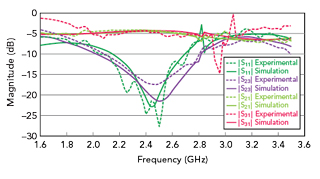
Figure 11 Measured vs. simulated |Sxx| of the classic Wilkinson power divider.
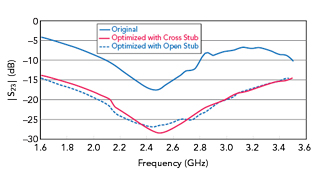
Figure 12 |S23| of the original, cross-stub and open-stub power dividers.
CONCLUSION
A novel version of a Wilkinson power divider uses a compact stub structure to achieve a 93 percent size reduction. The performance of two slightly different prototype designs agrees closely with the simulations and without compromise relative to the classic design. Actually, output port isolation is improved by 20 dB.
ACKNOWLEDGMENT
This work was supported by the Directorate General for Scientific Research and Technological development (DGRSDT) of Algeria.
References
- M. Steer, Microwave and RF Design, A System Approach, SciTech Publishing, Inc., 2010.
- J. S. Hong and M. J. Lancaster, Microstrip Filters for RF/Microwave Applications, John Wiley & Sons, 2001.
- A. Grebennikov, RF and Microwave Transmitter Design, John Wiley & Sons, 2011.
- K. C. Gupta, R. Garg, I. Bahl and P. Bhartia, Microstrip Lines and Slotlines, Second Edition, Artech House, 1996.
- D. M. Pozar, Microwave Engineering, Fourth Edition, John Wiley & Sons, 2012.
- T. Yang, C. Liu, L. Yan and K. M. Huang, “A Compact Dual-Band Power Divider Using Planar Artificial Transmission Lines for GSM/DCS Applications,” Progress in Electromagnetics Research Letters, Vol. 10, 2009, pp. 185–191.
- H. Oraizi and M. S. Esfahlan, “Miniaturization of Wilkinson Power Dividers by Using Defected Ground Structures,” Progress in Electromagnetics Research Letters, Vol. 4, 2008, pp. 113–120.
- N. Gupta, P. Ghosh and M. Toppo, “A Miniaturized Wilkinson Power Divider Using DGS and Fractal Structure for GSM Application,” Progress in Electromagnetics Research Letters, Vol. 27, January 2011, pp. 25–31.
- M. C. Scardelletti, G. E. Ponchak and T. M. Weller, “Miniaturized Wilkinson Power Dividers Utilizing Capacitive Loading,” IEEE Microwave and Wireless Components Letters, Vol. 12, No. 1, January 2002, pp. 6–8.
- M. Heydari and S. Roshani, “Miniaturized Unequal Wilkinson Power Divider Using Lumped Component Elements,” Electronics Letters, Vol. 53, No. 16, August 2017, pp. 1117–1119.
- M. Hayati and S. Roshani, “A Novel Wilkinson Power Divider Using Open Stubs for The Suppression of Harmonics,” ACES Journal, Vol. 28, No. 6, June 2013, pp. 501–506.
- X. Wang, M. Ohira and Z. Ma, “Coupled Microstrip Line Wilkinson Power Divider with Open-Stubs for Compensation,” Electronics Letters, Vol. 52, No. 15, July 2016, pp. 1314–1316.
- C. H. Tseng and C. H. Wu, “Compact Planar Wilkinson Power Divider Using P-Equivalent Shunt-Stub-Based Artificial Transmission Lines,” Electronics Letters, Vol. 46, No. 19, September 2010, pp. 1327–1328.
- I. J. Bahl and D. K. Trivedi, “A Designer’s Guide to Microstrip Line,” Microwaves, May 1977, pp. 174–180.
- K. L. Kaiser, Electromagnetic Compatibility Handbook, CRC Press Edition, 2–28, 2004.
- G. D. Vendelin, “Limitations on Stripline Q,” Microwave Journal, Vol. 13, No. 5, May 1970, pp. 63-69.
- H. Bosma, “On Stripline Y-Circulation at UHF, Microwave Theory and Techniques,” IEEE Transactions, Vol. 12, No. 1, January 1964, pp. 61–72.