

Gain and Directivity (see Figure 4)
- COMSOL: 5.7 dB gain, 7.7 dB directivity
- CST: 5.2 dB gain, 6.7 dB directivity
- HFSS: 3.0 dB gain, 5.5 dB directivity
- ADS: 4.3 dB gain, 7.7 dB directivity (provided only approximate estimates due to its limited 3D modeling capability).
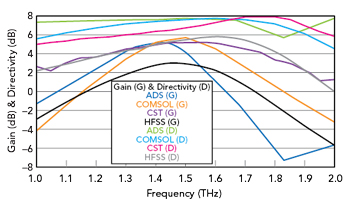
Figure 4 Antenna gain and directivity comparison.
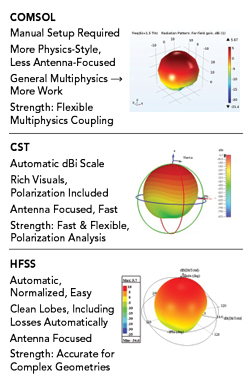
Figure 5 3D far-field radiation patterns using COMSOL, CST and HFSS.
Radiation Patterns (see Figure 5)
Far-field radiation results obtained from HFSS, CST and COMSOL demonstrate a broadside pattern characterized by a dominant main lobe and minimal sidelobe levels, aligning with the typical radiation behavior expected from a microstrip patch antenna.
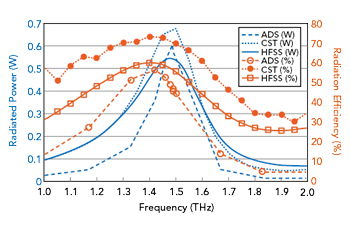
Figure 6 Radiated power and radiation efficiency comparison.
Radiation Efficiency and Radiated Power (see Figure 6)
- CST: 70.09 percent radiation efficiency, 0.341 W (with 0.5 W input) radiated power
- HFSS: 56.03 percent radiation efficiency, 0.549 W (with 1 W input) radiated power
- ADS (circuit-based loss estimation): ∼ 45 percent radiation efficiency, ∼0.557 W radiated power (with 1 W input)
- COMSOL: high mesh density requirements and solver instability beyond gain/directivity.
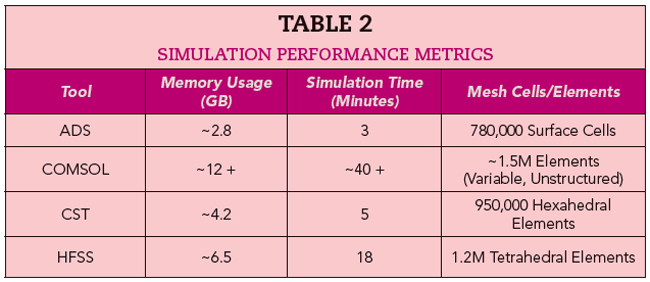
Simulation Time and Resource Consumption (see Table 2)
ADS (frequency-domain solver) is the fastest, completing the simulation in 3 minutes, followed by CST at 5 minutes. HFSS required 18 minutes due to adaptive meshing and frequency-domain computation. COMSOL required significantly more computational time and memory, taking over 40 minutes for basic field results, and exceeding hardware limitations when computing volume-based power and loss parameters. These observations highlight the challenges in using COMSOL for full-wave THz simulations, particularly regarding mesh management and solver stability.
Practical Insights for Engineers (see Table 3)
- HFSS: Best for high accuracy THz antenna modeling, but resource-intensive
- CST: Balanced choice: fast, accurate, user-friendly; well-suited for broadband and iterative design
- ADS: Fastest and simplest, ideal for quick planar S-parameter checks, but limited for full 3D THz analysis
- COMSOL: Powerful for multiphysics (thermal/structural + EM) but impractical for standard THz antenna design due to convergence issues.
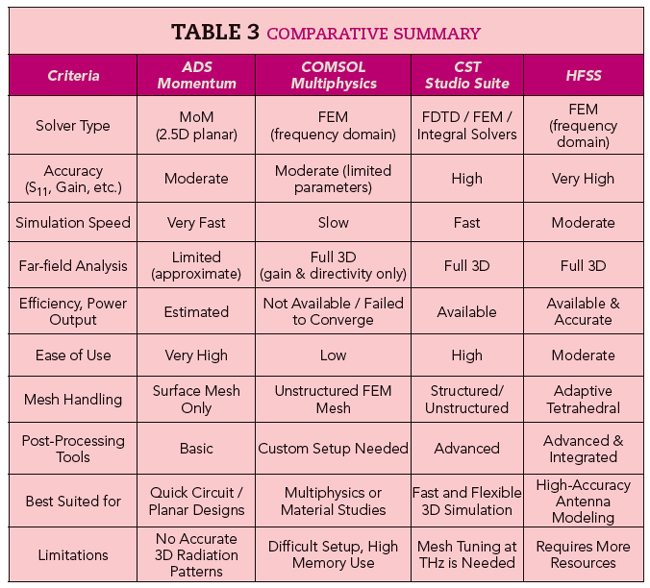
HFSS provides highly accurate results in terms of |S11|, gain, directivity and radiation efficiency. Its adaptive meshing and frequency-domain FEM solver make it especially reliable for THz antenna analysis, although it requires more time and memory. It is particularly beneficial for users requiring high accuracy and in-depth analysis of electromagnetic performance.
The CST Studio Suite closely matches HFSS in accuracy. Its time-domain solver offers faster simulation speeds, making it efficient for broadband studies. CST also provides flexibility through multiple solver options and a user-friendly interface, although solver selection and mesh setup may need careful attention at THz frequencies.
ADS Momentum is the fastest and easiest simulator to use for planar designs. It accurately predicts |S11| and provides useful impedance data but lacks the capability for full 3D far-field analysis. This limits its use for complete antenna radiation studies, especially at terahertz frequencies, where 3D effects are critical.
COMSOL Multiphysics provides |S11|, gain and directivity, but fails to converge for efficiency analysis due to mesh limitations at THz frequencies. Its FEM-based RF module is versatile and allows for custom material or multiphysics coupling, but the setup is complex and computationally intensive at THz scales. It is better suited for research requiring coupled thermal, structural or material effects.
Frequency-dependent variations among solvers arise from their numerical foundations and how they handle fine spatial discretization and material parameter scaling at THz frequencies. HFSS (FEM) uses adaptive volumetric meshing for high precision in resonant structures. CST (FIT) provides fast time-domain solutions but is highly sensitive to the spatial step size and boundary truncation. ADS (MoM) employs planar current approximation, limiting full 3D field accuracy at high frequencies. COMSOL (FEM) provides a flexible multiphysics environment that allows coupling EM, thermal and structural effects. However, its general-purpose solver requires higher memory and stricter mesh refinement for numerical stability in THz analysis.
These computational trade-offs contribute to frequency-dependent prediction differences among the tools. In summary, HFSS and CST are THz antenna simulations’ most balanced and accurate tools. ADS is ideal for quick, planar-focused analysis, while COMSOL is best reserved for advanced or multiphysics-driven applications. Tool selection should depend on project goals, available resources and user expertise.
FABRICATION AND MEASUREMENT FEASIBILITY AT THZ FREQUENCIES
Although THz antenna fabrication and characterization facilities are available at select research institutes, practical access remains limited due to high cost and specialized nanofabrication and measurement requirements. The proposed 1.5 THz antenna has compact dimensions, demanding nanofabrication-level precision and advanced THz measurement setups. Consequently, this study emphasizes a simulation-only comparative analysis among HFSS, CST, ADS and COMSOL. The intention is to provide researchers and engineers with a realistic understanding of each platform’s modeling behavior, usability and suitability for THz antenna analysis under current technological constraints.
CONCLUSION
In this study, “accuracy” refers to the consistency of simulated results relative to the theoretical 1.5 THz resonant frequency and the standard -10 dB return loss criterion. All tools met this basic requirement, but variations in mesh density, solver type and convergence behavior affected numerical precision and far-field consistency. For THz microstrip antenna analysis, HFSS and CST exhibit relatively consistent results in terms of simulation accuracy and far-field prediction. ADS proves effective for rapid impedance-based studies, while COMSOL is more appropriate for multiphysics-driven simulations involving coupled physical phenomena.
Overall, the choice of electromagnetic simulation tool should align with the project’s objective — whether it involves high-fidelity electromagnetic modeling, rapid prototyping or coupled-field analysis. Engineers and researchers may consider the following practical preferences:
- Detailed EM accuracy and control → HFSS
- Efficient 3D modeling and user-friendliness → CST
- Quick planar impedance analysis → ADS
- Custom multiphysics coupling and flexibility → COMSOL.
This comparative assessment highlights the trade-offs among leading EM design tools in the terahertz regime and provides a practical, experience-based reference for selecting appropriate simulation platforms suited to specific research and industrial design needs.
References
- M. Singh and S. Singh, “Design and Performance Investigation of Miniaturized Multi-Wideband Patch Antenna for Multiple Terahertz Applications,” Photonics and Nanostructures - Fundamentals and Applications, Vol. 44, No. 12, February 2021.
- M. Shalini and M. G. Madhan, “Design and Analysis of a Dual-Polarized Graphene-Based Microstrip Patch Antenna for Terahertz Applications,” Optik, Vol. 194, October 2019.
- C. A. Balanis, Antenna Theory: Analysis and Design, 3rd ed., Wiley, Hoboken, N.J., 2005.
- H. -J. Song and N. Lee, “Terahertz Communications: Challenges in the Next Decade,” IEEE Transactions on Terahertz Science and Technology, Vol. 12, No. 2, March 2022, pp. 103–117.
- D. M. Mittleman, “Perspective: Terahertz Science and Technology,” Journal of Applied Physics, Vol. 122, No. 23, December 2017.
- Z. Chen, X. Ma, B. Zhang, Y. Zhang, Z. Niu, N. Kuang, W. Chen, L. Li and S. Li, “A Survey on Terahertz Communications,” China Communications, Vol. 16, No. 2, February 2019, pp. 1∼35.
- T. Amini, F. Jahangiri, Z. Ameri and M. A. Hemmatian, “A Review of Feasible Applications of THz Waves in Medical Diagnostics and Treatments,” Journal of Lasers in Medical Science, Vol. 12, No. 92, December 2021.
- A. Youssef, I. Halkhams, R. El Alami, M. O. Jamil and H. Qjidaa, “A Simulation Study of Dual-Band THz Soft Antenna for Biomedical Applications,” Scientific African, Vol. 25, No. e02294, September 2024.