

The popularity of multimedia applications and broadband Internet has led to an ever-increasing demand for high data throughput in cellular and wireless networks. In the digital and computing world, data is generated and collected at a rate that rapidly exceeds the limit set by network operators. Thus, there is an increased need for high transfer rates to support large amounts of data for uninterrupted video streaming, file sharing, web browsing, social networking, real-time communication, and content downloading. The K-band and Ka-band, which span 18 GHz to 27 GHz and 26.5 GHz to 40 GHz, offer substantial spectrum ideal for high-capacity wireless communication links. The K-band, albeit limited by atmospheric attenuation, is particularly useful for water vapor. This makes it suitable for short-range applications such as radar and satellite communications. The Ka band excels at providing higher bandwidth and data transfer rates than lower-frequency bands. Its applications are critical in satellite communications, where it enables high-capacity connections for services like broadband internet.
According to MarketsandMarkets the global MMIC market was valued at USD 12,836.8 million in 2024 and is projected to reach USD 23,914.1 million by 2030, growing at a CAGR of 10.5% during the forecast period. The market for gallium arsenide (GaAs) MMICS is expected to be worth USD 12,076.6 million by 2030, growing at a CAGR of 9.3% during the forecast period. GaAs has a high dielectric constant and, unlike Si, provides natural isolation between microwave devices and underlying circuits. This property makes GaAs an ideal material for MMICS, where active and passive components can be manufactured on a single GaAs substrate. The gallium nitride (GaN) MMIC market is expected to grow at the highest rate of 17.8% during the forecast period, reaching USD 3,874.1 million in 2030. GaN MMICs offer the ideal combination of high power density and yield, high-voltage operation, and longevity. GaN MMICs offer greater heat-dissipation capabilities than other MMIC materials.
The MMIC-based RF front-end helps to upgrade smartphone technology from 4G to 5G for the upcoming advanced networks. The modern RF front includes MMIC low-noise amplifiers (LNA), power amplifiers (PAs), and switches and filters. In 5G and 5G advanced telecommunication infrastructure deployments, carriers increasingly deploy microwave backhaul. Microwave backhauls rely on the MMIC components, including power amplifiers and switches, to deliver the required data performance, which is expected to boost the MMIC market in the coming years.
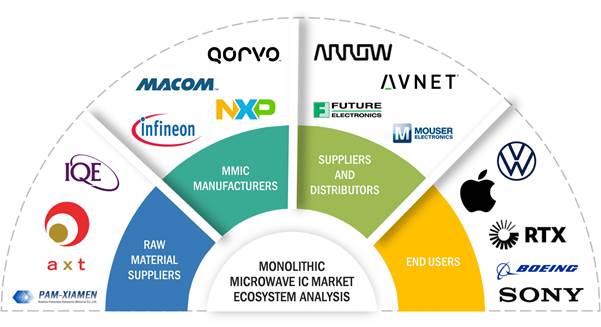
A few of the major companies in the monolithic microwave IC market are Qorvo, Inc. (US), MACOM (US), Skyworks Solutions, Inc. (US), NXP Semiconductors (Netherlands), Analog Devices, Inc. (US), Infineon Technologies AG (Germany), WIN Semiconductors (China), United Monolithic Semiconductors (France), Mini-Circuits (US), Keysight Technologies (US), MicroArray Technologies (China), VECTRAWAVE (France), BeRex (South Korea), Reliasat (UK), Semiconductor Components Industries, LLC (US), Wolfspeed, Inc. (US), Microwave Technology, Inc. (US), ASB Inc.(South Korea), Texas Instruments Incorporated (US), Northrop Grumman. (US), Toshiba Infrastructure Systems & Solutions Corporation (Japan), STMicroelectronics (Switzerland), Microchip Technology Inc. (US), Sumitomo Electric Industries, Ltd. (Japan), and Mitsubishi Electric Corporation (Japan).
TRENDS/DISRUPTIONS IMPACTING CUSTOMER BUSINESS
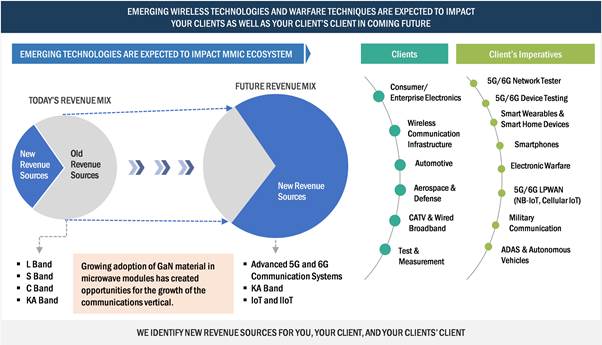
RISING USE OF MMICS IN SMARTPHONES
The rising demand for MMICs from the smartphone and automotive industries is driving growth in the MMIC market worldwide. MMICs are used in smartphones to improve weak-signal reception and increase data transfer rates. These circuits optimize data throughput within an allotted bandwidth by offering high-linearity performance with near-peak output, which is required for complex modulation. The use of MMICS in smartphones also enables the highest network efficiency, reduced transmission power, and the lowest bit error rates.
The use of smartphones has increased significantly worldwide over the past decade. In 2024 alone, smartphone shipments were ~1.2 billion units. This increase in the number of smartphone users can be attributed to declining smartphone costs, improved standards of living, and the ubiquity of the Internet. Additionally, mobile operators are integrating transformative solutions in their networks and adjusting business models to expand services and pursue commercial opportunities. According to the Groupe Speciale Mobile Association (GSMA), in 2023, mobile operators worldwide will invest USD 1.5 trillion in capital between 2023 and 2030, 90% of which will be for 5G (2).
INCREASING DEMAND FOR HIGH DATA THROUGHPUTS IN CELLULAR AND WIRELESS NETWORKS
The popularity of multimedia applications and broadband Internet has led to an ever-increasing demand for high data throughput in cellular and wireless networks. In the digital and computing world, data is generated and collected at a rate that rapidly exceeds the limit set by network operators. Thus, there is an increased need for high transfer rates to support large amounts of data for uninterrupted video streaming, file sharing, web browsing, social networking, real-time communication, and content downloading.
The K-band and Ka-band, which span 18-27 GHz and 26.5-40 GHz, provide a substantial spectrum that is ideal for high-capacity wireless communication links. The K-band, albeit limited by atmospheric attenuation, is particularly useful for water vapor. This makes it suitable for short-range applications such as radar and satellite communications. As the demand for high-speed data transmission grows, the K-band is increasingly used across various telecommunications infrastructures, enhancing data transfer efficiency in urban and dense environments. On the other hand, the Ka-band excels at providing higher bandwidth and data transfer rates than lower-frequency bands. Its applications are critical in satellite communications, where it enables high-capacity connections for services like broadband internet. The Ka-band's ability to support advanced technologies such as beamforming and frequency reuse allows for more efficient use of spectrum, making it a preferred choice for next-generation wireless networks.
This capability allows for gigabit-per-second data rates, making it essential for modern data-intensive applications such as 5G networks and fixed wireless access. E-band technology is being employed to connect mobile network base stations with core networks, providing the high capacity and low latency required to support advanced services such as video streaming and real-time communications 38. As mobile data consumption continues to rise, the reliance on E-band links will further increase. Moreover, many regulatory bodies have adopted flexible licensing approaches for E-band frequencies, often allowing lightly licensed or even license-exempt use. This regulatory environment facilitates the easier deployment of E-band technology, encouraging more companies to invest in MMICS operating within this spectrum.
MONOLITHIC MICROWAVE IC MARKET: ECOSYSTEM ANALYSIS
THRIVING AUTOMOTIVE SECTOR
The automotive sector is rapidly expanding, driven by the need for advanced technologies in-vehicle systems. According to MarketsandMarkets, the global advanced driver assistance systems (ADAS) market is expected to grow from 334 million units in 2024 to 655 million units by 2030, at a CAGR of 11.9%. The ADAS market is witnessing robust growth driven by rising demand for electric and autonomous vehicles, which is expected to drive the market for ADAS systems. Additionally, according to Invest India, the automobile sector is thriving, with robust foreign direct investment (FDI), and is expected to create around USD 5 million in direct and indirect jobs by 2030, particularly driven by the EV market.
The automotive sector's growth is also driving the MMIC market. MMICs are integral to radar systems used for various safety features such as adaptive cruise control, collision avoidance, and blind-spot detection. These systems rely on high-frequency signal processing to accurately detect objects and measure distances, enabling vehicles to respond quickly to their environments. Also, MMICs enable the operation of ADAS technologies, enhancing vehicle safety and driving comfort. They support functionalities such as lane departure warning, automatic emergency braking, and parking assistance by processing data from radar and sensor systems.
GROWING IMPLEMENTATION OF ADVANCED TECHNOLOGIES IN DEFENSE SECTOR
Countries' increasing Defense spending to upgrade their Defense inventories is significantly driving demand for advanced technologies. For instance, according to reports from the Stockholm International Peace Research Institute (SIPRI), major military spenders such as the US, China, Russia, India, and Saudi Arabia accounted for about 60% of global military expenditures in 2023. The US military budget alone reached approximately USD 916 billion, reflecting a growing trend toward enhancing defense capabilities through advanced technologies.
The global defense industry is witnessing surging demand for more advanced technologies as governments across countries are increasingly spending on upgrading their defense systems with these technologies. Increased demand for avionics systems, electronic systems, critical software, optronics, unmanned systems, missiles and munitions, subassemblies, and electronic surveillance systems from the global defense industry has driven a rise in MMIC demand worldwide.
Manufacturers of MMICS are investing in R&D activities to develop technologically advanced and improved MMICs and sophisticated radar and communication systems; these systems are crucial for applications such as surveillance, target tracking, and secure communication in military operations, which offer improved performance for use in land, sea, air, and space defense applications. MMICs provide the necessary performance characteristics to meet the stringent requirements of these applications.
RISING APPLICATION OF C4ISR-BASED ELECTRONIC WARFARE TECHNIQUES
One of the major drivers of the MMIC market's growth is innovation in warfare techniques. Companies in the MMIC ecosystem are constantly working to advance electronic warfare systems in line with requirements. Next-generation warfare emphasizes the integration of advanced technologies, such as autonomous systems and enhanced communication networks. MMICs are crucial for enabling high-frequency communication and radar systems, providing the necessary performance for real-time data processing and transmission. Moreover, the rise of unmanned aerial vehicles (UAVs), drones, and other autonomous systems relies heavily on MMIC technology for communication and navigation. These systems require high-performance integrated circuits to process signals efficiently, enabling them to operate independently in complex environments.
MMICs are increasingly used in electronic warfare (EW) systems, which are essential for modern military operations. These circuits enable sophisticated jamming, surveillance, and reconnaissance capabilities, allowing military forces to gain a strategic advantage on the battlefield. Aircraft manufacturers and government bodies are partnering with equipment manufacturers to develop new electronic warfare systems to provide better aircraft for use in military & defense applications. The Command, Control, Communication, Computer S Intelligence, Surveillance, and Reconnaissance (C4ISR) technology in electronic warfare systems is being used to maximize situational awareness and mission success. The growing use of C4ISR-based electronic warfare techniques and devices is expected to drive the growth of the MMIC market.
The technologies used for MMIC design are still evolving, leading to substantial financial hurdles in both development and manufacturing processes. MMICs are typically produced in low volumes, which inherently increases manufacturing costs because economies of scale are not realized. Materials used in MMICS, including GaAs, GaN, and indium phosphate, are rare. Owing to the unique characteristics of materials used in the development of MMICS, including their high costs, limited availability, and toxicity. The manufacturing of MMICS involves complex processes that require advanced technology and skilled labour. This complexity increases the overall development cost, as significant investments in equipment and facilities are required to maintain high-quality production standards. Moreover, MMICs used in most commercial and Defense applications are expensive, increasing the cost across the entire supply chain. The high cost is one of the major factors expected to restrain the MMIC market worldwide.
Consumers increasingly favor smaller, more portable electronic devices, so the need for compact MMICS has surged. MMICs enable the integration of multiple functions into a single chip, reducing the overall size and weight of devices without compromising performance. This is particularly evident in consumer electronics such as tablets, smartphones, wearables, and loT devices, where space is at a premium. Similarly, the healthcare sector is increasingly adopting miniaturized devices for health monitoring, such as wearable health trackers and portable diagnostic tools. MMICs play a vital role in these applications by providing reliable wireless communication and signal-processing capabilities essential for real-time transmission of health data.
Modern consumers prioritize portability, sleek designs, and enhanced functionality, which requires integrating advanced components into smaller form factors. E.g., portable entertainment systems, such as wireless headphones and portable gaming devices, also benefit from MMICS by offering robust Bluetooth or Wi-Fi capabilities with minimal power consumption. The trend toward miniaturization extends to personal medical devices, where MMICS enhance performance in compact equipment such as hearing aids and portable diagnostic tools, as the healthcare industry shifts toward more portable, user-friendly, and non-invasive monitoring systems. MMICs are emerging as a critical component in enabling these advancements. These circuits provide high-frequency operation, low power consumption, and integration of multiple functionalities, which are essential for modern healthcare devices. Wearable health monitors, such as smartwatches and fitness bands, rely on MMICS for wireless connectivity, enabling real-time tracking of vital parameters like heart rate, oxygen saturation, and blood pressure. MMICS compact size and low power usage make them ideal for applications where space and battery life are critical constraints. Similarly, in portable diagnostic devices such as glucose monitors, MMICS facilitate efficient signal processing and wireless communication, ensuring accuracy and usability in a compact form factor, making MMICs pivotal in meeting the industry's stringent size, power, and performance requirements and driving their widespread adoption.
A number of space programs are being planned across the world in the coming years by several renowned space agencies such as the National Aeronautics and Space Administration (NASA), the Chinese National Space Agency (CNSA), the European Space Agency (ESA), Roscosmos, the Japan Aerospace Exploration Agency (JAXA), and the Indian Space Research Organization (ISRO). These space agencies have completed several space missions and have several more in the pipeline in the near future. Communication plays a vital role in space missions, and MMICs are crucial components in such critical missions as they enhance the signals from spacecraft or satellites in space received by observatories on the Earth.
In January 2025, according to an article by NBC News, The Blue Ghost Lander is a significant lunar exploration mission conducted by Firefly Aerospace (US). This mission is part of NASA's Commercial Lunar Payload Services (CLPS) initiative, aiming to deliver scientific payloads to the lunar surface. Similarly, in November 2024, the Indian Space Research Organization (ISRO) embarked on the Human Spaceflight ("Gaganyaan") program to demonstrate human spaceflight capability to Low Earth Orbit in an Indian Crew Module, with up to three crew members, for up to three days, and to safely recover them after the mission. The IA enables Australian authorities to work with Indian authorities to support the search and rescue of crew and the recovery of crew modules as part of contingency planning for ascent-phase aborts near Australian waters. Thus, the increase in the number of space programs worldwide by leading space agencies is expected to present a growth opportunity for the MMIC market.
MMICS are used in cell phones, satellite communication systems, deep space probes, navigational systems, weather systems, automotive radars, radiometers, and global positioning systems, owing to their small chip size, excellent performance, and high-cost efficiency. Cell phones, satellite communication systems, deep space probes, navigational systems, weather systems, automotive radars, radiometers, and global positioning systems require high-frequency, large-bandwidth, and high-performance active circuits such as low-noise amplifiers, mixers, oscillators, power amplifiers, and switches. While designing MMICS, manufacturing costs and yields must be balanced to develop the best possible designs that cater to the requirements of the different applications in which they are used.
Choosing the right device in case of active circuits, minimizing cross-coupling and parasitic effect in layouts, reducing the die size, which is directly proportional to the cost, choosing the right package, and enhancing the performance of circuits by minimizing variations over temperature and bias voltage are a few of the major challenges faced by manufacturers of MMICS while designing them.