


Testbed Components and Configuration
Signal Generation: An R&S SMW200A vector signal generator (VSG) produces the standard-compliant 5G uplink signal. Channel emulation capabilities introduce realistic fading and noise. Crucially, a PA model is applied to the generated waveform before the wireless channel to emulate the nonlinear distortion introduced by the PA at different operating points.
- 5G Waveform Generation: The VSG forms the transmit side of the testbed. It generates a 5G NR uplink signal, configurable to emulate typical mobile device transmissions.
- PA Emulation: A key feature of the testbed is the ability to model the nonlinear behavior of a PA during signal generation. Instead of a physical PA, a mathematical model representing it is applied to the waveform that is transmitted by the R&S SMW200A. This allows controlled introduction of PA impairments without requiring an actual PA unit. The PA back-off setting, controlling the distance from saturation, is a crucial parameter for varying the level of distortion. This PA modeling approach allows researchers to rapidly iterate through different PA characteristics without requiring physical hardware changes, accelerating the development cycle.
- Channel Emulation: The R&S SMW200A incorporates channel emulation capabilities. This emulates the effects of the wireless propagation channel on the transmitted signal, adding realistic impairments. Configurable channel profiles can represent different deployment scenarios (urban, rural, etc.). The channel emulator can also be fed with wireless channel data generated in site-specific RF digital twins, for example, leveraging raytracing technology.
-
Signal Output: The impaired 5G signal is output from the VSG and fed directly to the receive side of the testbed.
Signal Analysis and AI Inference: An FSWX signal and spectrum analyzer, paired with Vector Signal Explorer (VSE) software, both from Rohde & Schwarz, captures the impaired 5G uplink signal. The R&S VSE has been extended to load and execute custom AI receiver models, enabling inference of user-defined AI models directly within the measurement application. - Signal Capture: The FSWX signal and spectrum analyzer captures the received, impaired 5G signal. Its wide bandwidth and high dynamic range ensure accurate signal acquisition.
-
VSE Software: R&S VSE is the central control and measurement application. It performs several critical functions:
- Demodulation and Baseband Processing: R&S VSE performs the initial demodulation of the 5G signal, bringing it down to baseband.
- AI Model Loading and Execution: This is where the HybridDeepRx AI model is integrated. R&S VSE is specifically extended to support loading user-defined AI models provided in the open neural network exchange (ONNX) format.
- Neural Network Inference Engine: R&S VSE utilizes a GPU-accelerated inference engine to execute the HybridDeepRx model on the captured signal data. This includes calculations within the CNN and residual network architectures in both time and frequency domains.
- Configuration Flexibility: Users can configure specific sections of the receiver chain to utilize either the AI model (HybridDeepRx) or the conventional 3GPP algorithms for channel estimation, equalization and demapping.
- KPI Measurement: R&S VSE calculates key performance indicators (KPIs) such as block error rate, throughput and bit error rate. These metrics quantify the receiver’s performance.
AI Model Integration and HybridDeepRx Processing: The HybridDeepRx model is loaded into VSE via an ONNX interface. The VSE utilizes GPU acceleration for neural network inference. It performs joint channel estimation, equalization and demapping. The configuration can switch between the neural-network-based demapper and a conventional 3GPP-compliant implementation.
- Time/Frequency Domain Translation: The model leverages FFTs and IFFTs to switch between frequency and time-domain processing, facilitating more accurate distortion mitigation.
- Joint Estimation, Equalization and Demapping: Unlike traditional receivers, HybridDeepRx performs these functions jointly within the neural network, improving overall detection accuracy.
Multi-Port Phase-Coherent Measurements
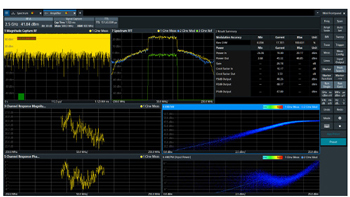
Figure 4 Screenshot from FSWX showing dual-channel measurement of amplifier input and output.
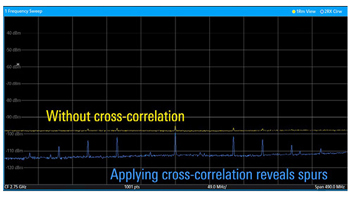
Figure 5 Cross-correlation capability revealing signals below the noise floor.
DPoD validation in MIMO systems requires observing signals across multiple antennas with precise phase relationships. The FSWX’s multi-port architecture, the first signal and spectrum analyzer with this capability, provides up to two 4 GHz bandwidth paths with phase-coherent measurements. This enables several critical capabilities for DPoD research:
- Simultaneous PA Characterization: The FSWX measures amplifier input and output concurrently, capturing both frequency-domain spectral regrowth and time-domain constellation distortion in a single acquisition (see Figure 4).
- Phased Array Validation: Users can verify beamforming performance across multiple antenna elements with maintained phase coherence.
- True MIMO Analysis: The FSWX observes spatial signal characteristics essential for understanding how nonlinear distortion propagates through MIMO channels.
The FSWX also offers cross-correlation capability, which represents a breakthrough in measurement sensitivity. By internally splitting a signal into independent paths and correlating the results, the analyzer effectively cancels its own noise floor, improving dynamic range by up to 15 dB in spectral measurements and up to 6 dB for in-band measurements. As Figure 5 illustrates, this proves particularly valuable when measuring signals near or below the analyzer’s native noise floor, such as characterizing receiver sensitivity or evaluating DPoD performance at cell edge conditions where signal-to-noise is marginal. For EVM measurements of high-order modulation (256-QAM, 1024-QAM), this extended dynamic range is essential for distinguishing true signal impairments from measurement system noise.
Wide Bandwidth Analysis for Beyond 5G Research
Looking toward 6G, the FSWX is also positioned for FR3 (7 to 24 GHz) research thanks to its internal analysis bandwidth up to 8 GHz. While current 5G NR specifies bandwidths up to 400 MHz in FR2, 6G research explores multi-gigahertz continuous signals to understand wideband channel effects and develop appropriate channel models. With its advanced filter banks (replacing traditional YIG preselectors) and broadband analog-to-digital converters, the FSWX enables clean, wideband captures without artifacts, which are expected to prove helpful for evaluating AI-enhanced receivers operating across these extreme bandwidths.
AI Inference in Measurement Flow
Integrating neural network inference into measurement systems requires computational infrastructure that traditional test equipment typically lacks. The VSE software can run on a standard PC and supports loading ONNX models and running GPU-accelerated inference, effectively bridging the gap between ML frameworks (e.g., PyTorch, TensorFlow) and RF measurement systems. This capability allows researchers to iterate rapidly, train models on captured or simulated data, deploy to hardware for validation, collect new measurements and refine training — closing the development loop without requiring custom hardware or extensive system integration.
CONCLUSION
AI-powered DPoD fundamentally redefines the receiver’s role in wireless systems, shifting it from passive signal recovery to active compensation for transmitter impairments. By leveraging base station computational resources and ML capabilities, DPoD can enable UE to use simpler, more energy-efficient transmitters while compensating for impairments at the receiver.
As the industry moves towards 6G, AI-driven DPoD is more than an incremental improvement. It typifies a broader shift to intelligent, adaptive network infrastructure that learns and optimizes rather than relying solely on predetermined algorithms. Equally important is the test and measurement ecosystem that enables this transition; advanced multi-port analyzers with AI inference capabilities will be vital to both research and practical deployment.
Advancing this vision requires sustained collaboration among algorithm developers, semiconductor vendors, network-equipment manufacturers, standards bodies and test and measurement providers. Success will be measured not merely by laboratory demonstrations but by real-world deployments in which billions of heterogeneous devices enabled by intelligent transmitters and AI-powered receivers deliver unprecedented gains in spectral and energy efficiency.
Reference
- J. Pihlajasalo et al., “Deep Learning OFDM Receivers for Improved Power Efficiency and Coverage,” IEEE Transactions on Wireless Communications, Vol. 22, No. 8, Aug. 2023, pp. 5518–5535.