


Electronic support measures (ESMs) play an integral role in military electronic warfare (EW) systems. They provide military intelligence via an array of surveillance devices used to perform critical tasks such as ‘listening’ to the enemy, identifying, intercepting, locating and analyzing sources of electromagnetic (EM) energy so that threats may be realized before they can harm.
At this fragile point in time, where the present geopolitical situation is unstable, military and defense organizations are on a high level of alert, and therefore, their reliance upon ESM is crucial. Thus, it is vital that ESMs are operated nominally, as a failure of these systems could mean an enemy’s successful attempt to permeate defenses.
A 2023 Forecast International report on the ESM market predicted that $7.2 billion would be spent in the next decade on a global scale. This gives an idea of just how critical these systems are and the role they play in underpinning situational awareness and informed decision-making.
ESMs are utilized on all platforms, including land, sea and air, and operate on the RF spectrum. Like all RF systems, they must be maintained to ensure accuracy and reliability. An important aspect of this maintenance is testing.
ESMs should be tested on a regular basis. The testing schedule is determined according to a number of factors, including the critical nature of the ESM, the current threat landscape, the need for compliance and frequency of mandatory testing, the risk profile of the system (how likely it is to be breached) and the budget available.
For vessels in particular, this maintenance can be problematic in addition to being costly. Vessels must be taken to a specific testing site with specialized equipment for testing ESMs, which are often far away from their operational location. This involves taking the vessel out of operational service for around two to three weeks as it travels to the port concerned, taking the crew with it.
Testing must then be completed and any issues resolved before it is allowed to return to base and resume normal operations. Despite the inconvenience, cost of validation and impact on operations, it is also imperative that testing is completed to guarantee the smooth running of ESM on board, and this cannot be compromised.
ESM TESTING
It is prudent to test an ESM both before deployment and once it has been deployed in its operational environment to ensure it can operate as expected in those conditions. At this point, testing should be more thorough to pick up issues caused by environmental factors. This will also help identify problems that equipment may have developed since type approval was granted. Testing should also occur when changes to the operational environment are identified, such as the installation of other equipment in the vicinity that may cause interference.
Software updates may also have an impact on ESM performance, and it may be necessary to verify capabilities following updates. This depends primarily on whether the update is major or minor. Testing should be prioritized after hardware changes, for example, repairing or replacing antennas, as these can also have an impact on ESMs. Similarly, testing should be prioritized when a network is expanded to verify that all is working well.
If problems are identified with the performance on ESM, it is important to continue testing to better understand the root of performance issues. Test failures can be due to age, malfunction or human error, and determining the cause prompts appropriate action to be taken to resolve the issue.
It is also important to test before any critical mission where failure of the equipment would be a serious problem. This ensures that any anomalies can be resolved and the system properly calibrated ahead of the mission.
THE IMPORTANCE OF REAL-WORLD TESTING
As with any system, there are shortcomings in ESM, and it is critical that the systems are geared up to operate in both current and future environments. Testing is the process that underpins this. However, testing in a lab environment can yield misleading results; therefore, testing in the real world, where daily operations occur, is essential to obtain an accurate picture of the ESM’s performance. Additionally, the signals that ESMs will face in the future are expected to become increasingly complex. For example, the multi-orbit satellite signals and next-generation active electronically scanned array radars are set to have big impacts on an already congested EM environment. They make the case for regular testing more vital for the continued effective operation of ESMs.
Enabling this testing has previously involved lab-based tests or range testing, where simulation of real-world scenarios has taken place. However, this involves having to transport the equipment to the lab at great financial and resource cost. This is especially challenging in defense environments where things change fast. Fortunately, there is another way to address this challenge, which enables the testing of ESMs in their operational environment, and it comes in the form of unmanned aerial vehicles (UAVs).
UAV TESTING: WHAT DOES IT INVOLVE?
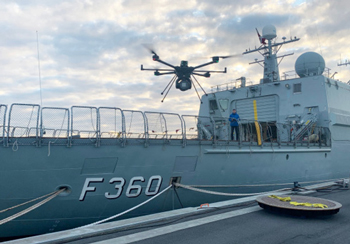
Figure 1 A UAV with an RF payload flying near a ship.
Testing with UAVs is still a new concept to defense forces. By their nature, UAVs are easy to transport and can be fitted with many different types of payloads to fulfill different tasks and applications. Instead of sailing a vessel all the way to a test site, which will result in the loss of hours of operations due to its being removed from service, and loss of man-hours as the crew must remain on board yet cannot operate, a drone is deployed to the vessel to carry out the ESM testing. Figure 1 shows a Class 1 UAV equipped with an RF payload getting ready to begin a measurement.
On vessels, as on any other platform, every system that is deployed impacts every other system around it. That system can be tested on a sub-system in a lab and given a clean bill of health; however, when deployed out in the field, it is surrounded by multiple systems and under the influence of various environmental factors. The interference of these systems and environmental challenges can be significant and negatively impact the performance. In addition, not all negative environmental factors are obvious to observe. For example, in the case of antennas, reflectivity can have an impact on how RF signals are received and can cause degradation and loss of throughput, neither of which is obvious to the naked eye. Any drop in performance can have a significant impact on services, affecting the accuracy and reliability of the system, so it is critical to ensure that the right testing regimes are put in place to evaluate the system in its own environment.
It can be complex and often time-consuming to test, correct and optimize the different components. If a system is tested out in the field, in situ, these different factors can be considered and dealt with before being retested. Using a drone to carry out the tests and to pinpoint where the issues are means that there is no requirement to get the vessel to a specific dock where it can be tested.
Fitted with a specialized payload that covers a wide range of frequencies from very low to very high, the UAV can be positioned at different elevation angles, emulating threats at various altitudes, thus ensuring performance checks and calibration across the entire operational range of the ESM system. Figure 2 shows an operator getting ready to run a test from a UAV.

Figure 2 An on-ship operator ready for take-off.
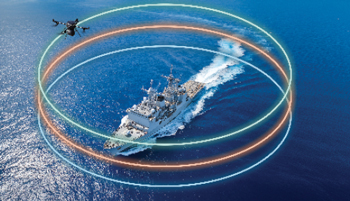
Figure 3 Examples of flight paths taken by the drone around a ship.
The drone is flown either in circles at different altitudes or away from or towards the ship, as demonstrated in Figure 3. The position of the drone is then compared to the information collected by the ESM system, allowing for an assessment of detection quality as well as for calibration of any misalignment offsets. In Figure 3, each flight path is a concentric circle around the ESM at different elevations. These flight paths would emulate targets coming from different directions and elevations, essentially testing the entire operational range of the ESM.
The drone is able to achieve highly accurate measurements due to the centimeter-level positioning of the real-time kinematics (RTK) GNSS. Even at over 100 meters of test distance, it puts the measurement uncertainty below a tenth of a degree.
Using multiple payloads that test different frequencies, the drones give flexibility and range to the testing process, offering the operators insight into exactly what is being emitted by satcom and radar in real time and the ability to calibrate those systems before testing again for on-vessel validation. Figure 4 shows an example of the results of pointing error after a test at different elevations. These errors can be translated into system offsets, which are then used as corrections on actual targets.
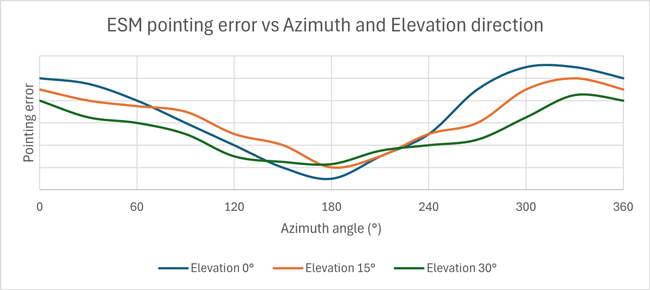
Figure 4 Example of results of pointing error after a multi-elevation test.
Investment in a system of this kind can result in long-term cost savings. To test the ESMs on board a vessel costs tens of thousands of dollars, but once a drone system has been invested in, the return on investment outweighs its cost. Results are in real time, allowing immediate action and rectification to avoid further issues. The frequency of testing can also be increased to ensure that the ESMs are continuously performing as they are expected to, with no disruption to the vessel’s daily operations. These measurements can be completed whilst the ship is in motion, going towards a destination or performing other critical activities, without impacting the measurement accuracy.
The drone payload can be used to self-test on board the vessel between missions, for EW training and fleet readiness exercises and for in-theatre validation of threat libraries. In addition, it can be used to verify the system integrity after maintenance and for crew training and blind zone mapping to detect any coverage gaps or areas of degradation.
INTELLIGENCE GATHERING
The use of drones equipped with RF payloads in the battlespace environment also lends itself to intelligence gathering. By pairing a highly effective payload with a long-endurance, resilient unmanned aircraft system (UAS) platform, a highly effective, scalable and tactically agile solution is created, enabling real-time EM spectrum intelligence in complex operational environments.
This kind of advanced spectrum monitoring tool is essential for modern operational environments. The drone effectively becomes an EM support measure that can listen for signals around the vessel without emitting a signal of its own. If the drone is used to map the EM environment, commanders can build up a detailed picture of where the enemy is located, where the threats lie and the type of communications networks that are being used. This can also provide them with immediate warnings of danger to the vessel and assure spectrum dominance, which is the goal of any force in EW situations. Across a mission, the drone provides enhanced situational awareness at a lower cost than other methods, enabling the command chain to see the bigger picture and therefore make more informed and timely decisions when it counts.
Ships equipped with these spectrum monitoring tools can apply them to EW and RF systems as well. Such drone payloads can generate radiation patterns, calibrate and optimize antennas, troubleshoot malfunctions and provide an overall health check of a multitude of systems.
Protecting a Vital Line of Defense
For navies all over the world, testing is fraught with challenges, and the method of testing is inefficient and often ineffective, as testing environments cannot replicate real-world scenarios. Additionally, current test methods are costly, and the expense must be laid out at least twice a year if the ESMs on board are to operate nominally.
UAVs offer a different, highly flexible approach to testing, enabling validation to be carried out in situ rather than involving redirection of the vessel to a port with testing facilities. The importance of the ability to test in the actual operational environment cannot be underestimated, especially given the increasing complexity of the RF landscape. New developments are causing unexpected congestion, and the crowding is expected to increase further with the deployment of new and evolving technologies. Testing with a UAV puts defense forces on the front foot, saving money and allowing them to see how ESMs are performing in real time, enabling them to recalibrate and test again.
Ownership of UAVs and RF payloads allows flexibility in testing. Once a system is invested in, it can be used to test ESMs on multiple platforms, eliminating the need for them to be taken out of service for long periods and encouraging more regular testing, which has a positive effect on the quality of monitoring.
In a world that is unpredictable, ESMs are imperative to offer situational awareness and information on both allied and enemy intent. Therefore, the meticulous maintenance of these systems cannot be compromised, and UAV testing enables validation without the litany of challenges that in-port testing presents.