

CELLULAR COMMS EVOLUTION FOR IOT
The evolution of cellular communications has been pivotal in meeting the specific needs of IoT. With 3GPP Releases 10 to 12 (4G LTE-Advanced), enhancements were introduced to support low-data-rate, robust and power-efficient connectivity.1 This marked a critical turning point, further accelerated by the emergence of 5G reduced capability (RedCap), which caters to devices requiring more throughput than LPWAN solutions, such as NB-IoT, but less than full-scale eMBB. RedCap achieves lower complexity and cost by limiting antenna count, bandwidth (20 MHz maximum) and modulation schemes (64QAM or optional 256QAM).2
A key enabler of rapid innovation in smartphones, and increasingly in IoT devices, is the modularization of the RF front-end (RFFE). This modular approach allows designers to selectively integrate optimized components for various frequency bands and functionalities. IoT devices, such as connected watches, benefit from this by repurposing proven smartphone RFFE modules, resulting in faster time-to-market and reduced design complexity. Modularity offers an added advantage: the reuse of proven, reliable RF technologies such as RF-silicon-on-insulator (SOI), piezo-on-insulator (POI) and fully depleted (FD)-SOI.
WI-FI COMMS EVOLUTION FOR IOT
Wi-Fi 7 brings significant improvements to IoT environments, especially in dense deployments. It increases modulation order from 1024QAM to 4096QAM, doubling peak data rates. It also expands multi-user capabilities through multi-user MIMO, now supporting up to 16 x 16 streams. These features increase network capacity, range and reliability.
To support higher network demands, Wi-Fi 7 incorporates multi-link operation (MLO), allowing devices to maintain simultaneous connections across multiple frequency bands, including 2.4 GHz, 5 GHz and 6 GHz, as demonstrated in Figure 1. This reduces latency and minimizes disruptions during frequency handovers. Additionally, the multi-user resource unit feature enhances interference resistance by selectively blocking only affected channel sections, maintaining optimal performance, as seen in Figure 2.
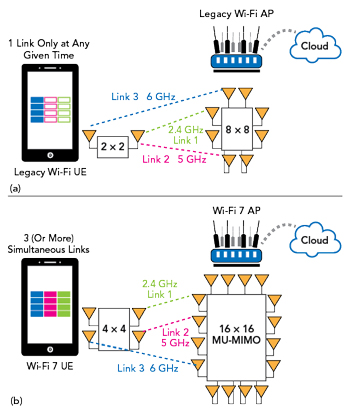
Figure 1 Wi-Fi (a) without MLO and (b) with MLO.
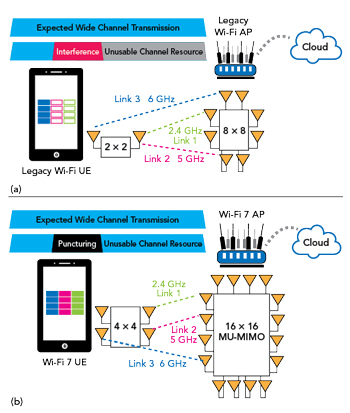
Figure 2 Wi-Fi channel (a) without and (b) with puncturing.
An additional innovation is the use of non-linear power amplifiers (PAs) in the Wi-Fi RFFE, which reduces power consumption by up to 25 percent compared to traditional linear amplifiers.3 These PAs are linearized by AI-assisted digital predistortion (DPD) for calibration.4 Integration of RF-SOI-based switches, low noise amplifiers (LNAs) and PAs in compact dies supports a broad range of compact IoT designs, as shown in Figure 3.
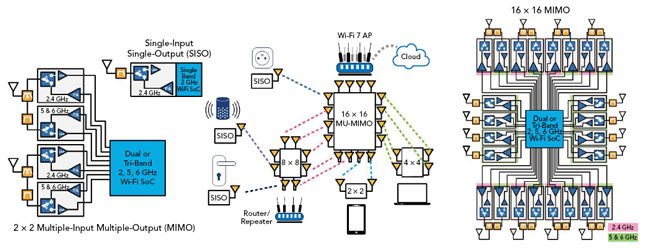
Figure 3 Example of Wi-Fi multi-user MIMO RFFE modular design.
Finally, dual 5G and Wi-Fi connectivity ensures robust, seamless transitions for IoT gateways and routers. This integration supports multi-gigabit throughput and ultra-low latency, critical for both consumer applications and industrial use cases.
IOT RFFE CHALLENGES AND SOLUTIONS
As IoT devices proliferate, RFFE modules face increasing demands for performance, integration and interference management. This overview highlights key semiconductor challenges and solutions across Wi-Fi and cellular applications. The insights gained are applicable across other wireless technologies as well.
ENSURING RFFE SIGNAL INTEGRITY
CMOS on RF-SOI substrates enables high performance switches with excellent isolation and low insertion loss.5 For example, a true wireless stereo earbud uses an RF-SOI switch to suppress parasitic signals, improving audio quality while reducing power consumption and extending range.
Interference is a common challenge in dense RF environments. Third-order intermodulation (IMD3) can arise from harmonic mixing of nearby cellular and Wi-Fi frequencies or between power management ICs and transmission signals. These interferences can compromise reception. Figure 4 shows an example of these interferences at 5.8 GHz.
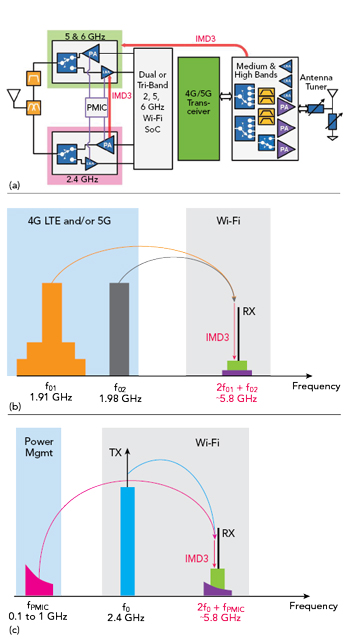
Figure 4 (a) RFFE IMD3 interferers generated by (b) cellular and Wi-Fi and (c) PMIC and Wi-Fi signals.
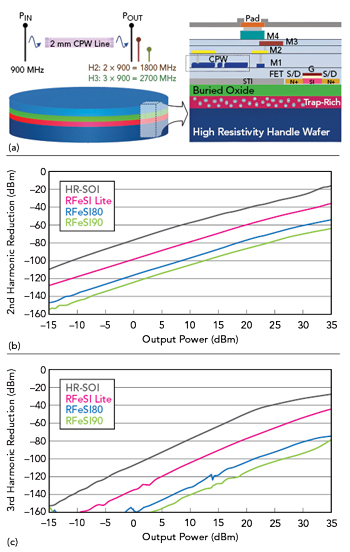
Figure 5 (a) CPW on an RFeSI™ and its measured (b) HD2 and (c) HD3 on different substrates.
Soitec’s trap-rich RF-SOI substrates (RFeSI™) minimize harmonic distortions such as HD2, HD3 and IMD3 wherever they may appear in the RFFE.6,7 Compared to high-resistivity SOI (HR-SOI), these engineered substrates further suppress signal distortion, as shown in Figure 5, where:
- RFeSI™: Soitec’s RF enhanced signal integrity trap-rich RF-SOI substrate
- RFeSI90: RFeSI™ with CPW HD2 below -90 dBm at 15 dBm power
- RFeSI80: RFeSI™ with CPW HD2 below -80 dBm at 15 dBm power
- RFeSI lite: RFeSI™ for IoT “lite” complexity
- HR-SOI: High resisitivity non-trap-rich SOI substrate.