


The increased number of more complex sensors, such as high-definition video and MIMO radar, required to implement higher levels of autonomous driving and the consumer requirement for data-rich infotainment such as streaming HD video and real-time gaming, are driving up the volume and data rates of in-vehicle networks and the processor power needed in the high performance computer (HPC). This also necessitates more complex and faster testing of the HPC. Current semiconductor-based switches used to test the HPC do not have the necessary linearity, speed or isolation for the next generation of HPC with PCIe Gen6 signals running up to 64 Gbps. Furthermore, they cannot meet the demands of high-precision DC parametric test sequences.
Significant research has been conducted in recent years to develop a new switch category able to address and support the test and measurement of existing and next-generation chip-based products advancing high speed Ethernet, PCIe Gen6 and future generations, as well as SerDes. The multitude of communication platforms and protocols drives switch technology to greater density in smaller form factors and reduces power consumption to minimize heat while expanding frequency coverage, life expectancy and linearity. Today’s microelectromechanical systems (MEMS) switches, such as those from Menlo Micro, deliver linearity of IP3 > 90 dBm and insertion loss below 1 dB across a frequency range of DC to 50 GHz. This performance enables test capabilities for accuracy and integrity across even the most demanding IC testing environments. Figure 4 shows Menlo Micro’s platform switch, which enables high speed digital testing of in-vehicle integrated circuits, providing the signal integrity, insertion loss and isolation essential for validating current and next-generation in-vehicle systems. Figure 5 shows eye diagram data through the Menlo Micro switch showing 64 Gbps PAM4 performance.
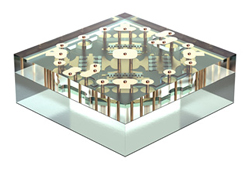
Figure 4 Menlo Micro’s RF platform switch.
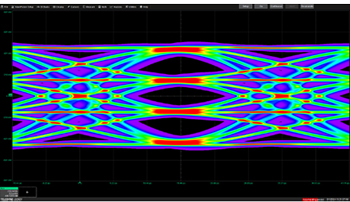
Figure 5 Eye diagram data through the Menlo Micro switch.
As Russ Garcia, CEO of Menlo Micro, observes, “Faster data rates and high speed buses are essential for next-generation applications, especially edge AI and automotive connectivity that enable autonomous driving and other critical services to the car. This is increasing the need for ultra-fast linear testing, not previously available, for HPCs, xPUs and other semiconductors and IoT devices. System-in-package solutions, based on MEMS switch technology, provide the automotive ecosystem with a fully integrated differential loopback testing solution designed for demanding high speed digital applications based on the latest SoC interconnections, SerDes and PCIe Gen 6 standards.”
SATELLITE CONSIDERATIONS
Moving from the vehicle to the satellite, one of the primary considerations of satellite design to enable NTN is the wireless link, and this places demand on the beamforming. Agile, efficient and effective beamforming is critical to ensuring the availability and quality of service of the NTN communications link. However, system designers need to reconcile these requirements without burdening the satellite with an impractical demand for size, weight and power. On satellites, switches fulfill the role of routing signals in the payload and control the operation of attenuators and phase shifters that feed phased-array antennas to manage the beamforming. A typical satellite may host hundreds of switches.
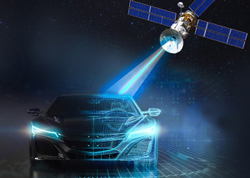
Figure 6 A rendering of NTN automotive connectivity.
Similar performance demands placed on switches by high speed digital test needs align with the needs for chip-scale solutions for high-power miniature wideband beamformers. Beamforming is essential for NTN connectivity, with satellite switches routing signals and controlling phased-array antennas under strict SWaP constraints — mirroring performance demands seen in high speed digital test systems. For example, a beamformer typically consumes up to 25 percent of a satellite’s energy budget. By replacing the beamformer’s solid-state switches with MEMS switches and taking advantage of the favorable power consumption and insertion loss, the power consumption can be reduced to less than 5 percent of the energy budget without compromising reliability. Furthermore, the frequency range over which the switch can achieve less than 1 dB of insertion loss is from DC to 50 GHz. Linearity issues in the RF domain degrade the spectral purity and give rise to unintentional modulation. Because the linearity of the MEMS switches can be several orders of magnitude superior to typical solid-state switches, the system can operate at higher powers without significant distortion, thus improving energy efficiency and the quality of the service delivered over the system to end users. It forces a rethink of the multi-band approach to payload design towards unified ultra-broadband satellite communication systems as well as beamformer solutions on future vehicle platforms. Figure 6 shows an artistic rendering of satellite-to-car connectivity.
Historically, system engineers have had to make difficult switch selection decisions, trading off specifications between electromechanical relays (EMRs) and solid-state switches, and accepting the associated compromises. EMRs offer lower insertion loss and higher power handling, whereas solid-state switches can cover higher frequency ranges and have longer life expectancy. Semiconductors, as the name implies, are inherently lossy, which impacts the efficiency and energy budget of the host device, consuming power and generating heat, even when in the off state. The compromises inherent in these two options create a bottleneck restricting the migration to the energy-efficient, compact and low-cost satellites required for NTN constellations.
TEST AND MEASUREMENT
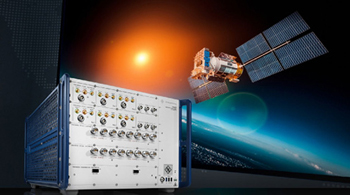
Figure 7 The Rohde & Schwarz CMX500.
For NTN chipset developers, TCU vendors, OEMs and the satellite supplier, a key challenge is how to ensure the functionality of modules and the end-to-end system without an available operational network to verify performance. Test and measurement vendors such as Rohde & Schwarz fulfill a critical role by providing test equipment able to emulate NTNs in the lab. A radio communications tester such as the Rohde & Schwarz CMX500, shown in Figure 7, can emulate the end-to-end network, including the radio channel and the core, to provide comprehensive handover, including TN to NTN, NTN to TN, intra- and inter-satellite, as well as interoperability testing of modules and devices from different vendors. The physical distance from the vehicle to the satellite causes a very long delay, so verifying time synchronization is another crucial test performed by the radio communications tester.
Holger Rosier, technology manager at Rohde & Schwarz, states, “NTN is the emerging dimension in automotive connectivity, promising ubiquitous vehicle connectivity. How well the ecosystem can address the challenges of latency, new frequency bands, the Doppler effect, fading and integration with terrestrial networks will determine the speed at which NTN is adopted. Validation of antenna design, transceiver performance, handover and protocol conformance are essential to ensuring correct operation of NTN and the applications it will support.”
The movement of LEO satellites causes a significant Doppler shift, so a tester is required to ensure correct frequency synchronization between the satellite and the device it serves. NTN also presents specific test challenges to verify the propagation of the signal from ground to satellite and vice versa. Here, new fading profiles such as the combination of atmospheric and terrestrial fading and the emulation of weather-specific effects can be integrated into the test setup, usually provided by the radio communication tester. The addition of a GNSS simulator, such as the Rohde & Schwarz SMBV100B, to the test setup enables GNSS measurements, including constellation-specific satellite ephemerals.
Key test categories include RF, protocol, application, carrier acceptance and interoperability testing. These tests are conducted by accredited test laboratories within the industry, adhering to standards set by GCF and PTCRB for certification as well as regulatory requirements. Before an NTN-enabled device is released to the market, conformance testing is required to ensure compliance with specific technical standards, such as those set by 3GPP, ETSI, FCC and ITU.
CONCLUSION
Vehicle OEMs have the vision of the always-connected vehicle, particularly with the migration to high levels of autonomous driving and the realization of software-defined vehicles. However, significant limitations still exist in the coverage of TNs, so the potential for NTNs to offer a complementary method of providing wireless connectivity to vehicles is being actively examined. Key market enablers are the commoditization of satellite launch technology and the integration of NTN into 3GPP, while key technological enablers are the development of appropriate vehicle antennas, upgrade of TCUs and in-vehicle networks and the enhancement of satellite beamforming enabled by advanced MEMS switches.
As HPC data rates increase to gigahertz, the boundary between the digital domain and the RF domain becomes blurred, bringing a requirement for high linearity, ultra-fast IC testing, which the application of MEMS switches can address. Network emulation provided by test equipment vendors is critical to allow the development of NTN components, modules and systems without available operational NTNs. Although there is considerable uncertainty in the roadmap for narrowband, wideband and broadband use cases, there is a critical role for NTNs to provide continuity of automotive connectivity.
Acknowledgment
We would like to acknowledge Menlo Microsystems, Microchip, BMW Group, Rohde & Schwarz and the 5G Automotive Association for their valuable contributions to this article.
References:
- “Maximising the Benefit of Future Satellite Communications for Automotive,” 5GAA, September 2024.
- “5G NTN Takes Flight: Technical Overview of 5G Non-terrestrial Networks,” Reiner Stuhlfauth, Rohde & Schwarz, PD 3683.7383.52, Version 01.00, July 2022.
- “Vehicle Features Supported by Wireless Connectivity,” Rohde & Schwarz, PD 3608.9518.82, V01.02, September 2023.
- O. Eckart, “Satellite-based Communication: Benefits and Requirements from the Perspective of the Automotive and Transport Industry,” BMW Group, July 2025.
- P. Hansen, “Update on Networks,” The Hansen Report, July 2024.