


FIELDING SYSTEMS
ATCS is currently in the installation process. The plan is to install the system on 34 amphibious ships over the next several years. This will provide a sustainable and evolvable communications pathway for ship-to-ship and ship-to-shore line-of-sight communications, leading the DON capabilities into the future. Figure 3 shows an ATCS rack.
The ATCS shipboard radio is a complete multi-channel, multi-band system of systems that enables a unified heterogeneous wireless network (HETNET) capable of supporting different types of users in contested and congested electromagnetic spectrum (EMS) environments. A HETNET can be several different things depending on the context. In this instance, it is a wireless network with different access technologies.5
Spectrum supportability decisions align with domestic and international laws. Federal systems, including the Navy’s ATCS SDR, must follow the National Telecommunications and Information Administration (NTIA) Manual of Regulations and Procedures for Federal Radio Frequency Management.6 International systems must also follow the International Telecommunications Union (ITU) spectrum standards. These regulations ensure that systems are certified for their spectrum bands and that any conflicts are discovered and resolved during design. The DOD recognizes that the EMS, like fresh water, is a precious commodity and a maneuver space essential to all warfighting domains: land, air, sea, space and cyber. To effectively operate for humanitarian missions and on the battlefield, all participants need access to the EMS. Operating across multiple frequency bands increases the effectiveness of the system and the warfighter. The ATCS multi-band capability provides the DON with secure communications in environments where satcom capabilities are limited or nonexistent. As in the civilian sector, the federal government recognizes that the same is true; the backbone of American society runs on the EMS: science, communications, commerce and emergency services.
Figure 4 shows how ATCS can be integrated into ground-based U.S. Army- and shore-based USMC-compatible communication systems. The USN to USMC ship-to-shore communications capability has been a requirement for the DON since the mid-1990s. As warfare requirements and technology have evolved, this requirement has remained an absolute necessity. As shown in Figure 4, communication between the USN and the USMC is critical because they operate as a combined force, requiring seamless information sharing to execute complex and dangerous missions effectively. This is especially true during amphibious operations where the USMC rely on landing vessels for transport and fire support, necessitating reliable communications for coordinating movements and decisions during humanitarian and battlefield operations.
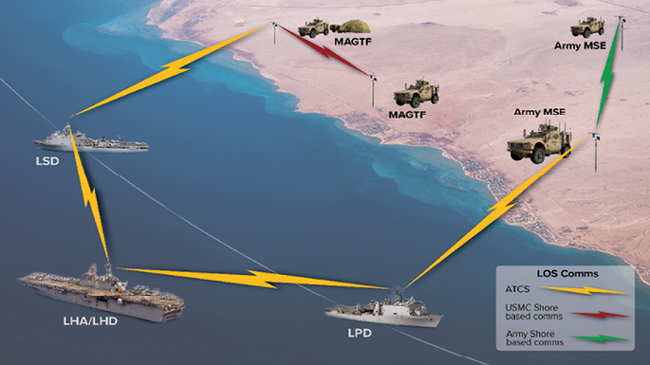
Figure 4 Operational concept for ATCS integration into Army and USMC-compatible communication systems. Source: U.S. Navy.
The ATCS radio was developed and produced by Ultra Electronics, who also make the Orion X500 software-defined tactical radio system used by the USMC for line-of-sight communications. The Orion radio platform is already in use across the DOD. This procurement ensures that the DON has interoperability with the U.S. Army and U.S. Special Forces, who already use the system. It is replacing a traditional, inflexible, hardware-based radio system developed and deployed during the 1990s. The Orion radio is also currently used by the Canadian Department of National Defence and the U.K.’s Ministry of Defense in addition to the U.S military. This broad usage enables coalition operations.
THE IMPORTANCE OF SDRS
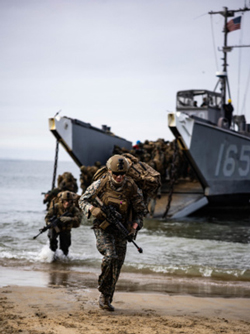
Figure 5 U.S. Marines executing a simulated amphibious assault. Source: U.S. Marine Corps.

Figure 6 Marines setting up MRC-142 radio antenna. Source: U.S. Air Force.
Just as amphibious warfare is critical to the offensive posture of the modern naval force, reliable and secure communications are crucial to successful amphibious operations. SDRs enable TRRs, which are crucial to the mission of the modern military. TRRs are secure and efficient point-to-point communication networks allowing military forces to communicate across the world’s diverse terrains without wires. Using multiple systems in a relay builds in redundancy, ensuring reliability. By hopping transmissions across shorter distances, the military forces can achieve their objectives with lighter-weight, more portable equipment. Figure 5 shows a stock photo of forces from the USMC executing a simulated amphibious assault.
The ship-to-shore communications portion of ATCS is critical to the DOD and naval forces. It enables critical information to be exchanged between ships and land-based command centers. This enables operations coordination and overall situational awareness, bringing together the naval forces’ land and sea-based portions.
In the USMC and the U.S. Army, the Orion family of systems is replacing older systems that have been in use since the early 2000s. These systems have provided a ship-to-shore and shore-to-shore TRR capability to forward positions such as operating bases, checkpoints, command posts and other widely dispersed units across Haiti,7 Iraq and Afghanistan. As seen in these areas, the units involved in counterinsurgency and humanitarian missions are scattered across wide areas with minimal reach-back support. This makes reliable communications essential to mission success. Figure 6 shows Marines setting up an MRC-142 radio antenna for line-of-sight, point-to-point radio communications.
COALITIONS
The success of contemporary military operations is contingent upon establishing secure and sustainable communications in congested and contested electromagnetic environments. Currently, militaries worldwide seldom operate in isolation; instead, they collaborate as members of coalitions. In addition to facilitating the exchange of knowledge, innovative practices and technologies across cultural and physical borders, this coalition-based approach also enhances combat effectiveness by capitalizing on the collective strengths of allied nations. This interoperability is essential in dynamic operational environments, promoting adaptability and agility.
Similarly, commercial communication systems are no longer restricted to specific nations or regions. For these systems to continue to be commercially viable, they must be able to support global operations across multiple countries, each with its own regulatory frameworks and spectrum allocations. This global approach to design and deployment guarantees that systems can function seamlessly in a variety of environments while simultaneously addressing obstacles such as varying levels of technological infrastructure, frequency allocations and spectrum usage rights. It is essential to harmonize and integrate these diverse requirements to guarantee SDRs are universally functional, scalable and reliable, regardless of whether they are used in military or commercial settings.
CONCLUSION
SDRs represent a transformative advancement in global communications, offering the flexibility to adapt to diverse operational environments. The ability of SDRs to operate across multiple bands, modulation schemes and protocols highlights their versatility, especially in congested and contested electromagnetic spectrum environments. Spectrum supportability is a cornerstone of SDR deployment, ensuring these systems comply with domestic and international regulations, operate without interference and meet mission-critical demands. The integration of spectrum harmonization across countries further amplifies the utility of SDRs, enabling seamless operation in coalition and multinational environments. SDR flexibility, robust spectrum supportability processes and global spectrum harmonization pave the way for reliable, secure and interoperable communications, enhancing military and commercial operations in an increasingly interconnected world.
REFERENCES
- Digital World, “Managing Growth, Managing Spectrum: Best Practices in Spectrum Harmonization,” ITU Telecom World, September 21, 2021, Web: https://digital-world.itu.int/managing-growth-managing-spectrum-best-practices-in-spectrum-harmonization/.
- P. R. Clayton, Introduction to Electromagnetic Compatibility, 2nd Edition, Wiley-Interscience, 2006.
- Chief Information Officer (DOD CIO), Policy and Procedures for Management and Use of the Electromagnetic Spectrum, Washington, District of Columbia: Department of Defense, January 9, 2009, Incorporating Change 1, October 17, 2017.
- R. Reiner, director, “The Princess Bride,” Twentieth Century Fox, 1987.
- R. Akeela and B. Dezfouli, “Software-defined Radios: Architecture, State-of-the-Art, and Challenges,” Computer Communications, Vol. 128, 2018, pp. 106–125.
- National Telecommunications and Information Administration (NTIA), “Manual of Regulations and Procedures for Federal Radio Frequency Management,” District of Columbia: Department of Commerce, 2021, Revised January 2023.
- Defense Media Activity Anacostia, “UPDATE: U.S. Navy delivers assistance, capabilities to unified response in Haiti,” Militarynews.com, January 10, 2010, Web: https://www.militarynews.com/norfolk-navy-flagship/news/top_stories/update-u-s-navy-delivers-assistance-capabilities-to-unified-response-in-haiti/article_26b401c0-a768-582f-ad1e-237ad35c24e2.html.