


The InP-based high electron mobility RTD that Canon developed operates at 0.45 THz without requiring frequency multipliers. This eliminates bulky and power-hungry components, reducing the overall size and power consumption of the final assembly. This source delivers 11.8 mW of power at 0.45 THz with a power efficiency that is 1.4x better than conventional RTDs. It has a directivity of 13 degrees and the semiconductor chip has a 3.2 mm2 footprint. The size reduction afforded by the InP-based light source versus a competitive solution is shown in Figure 3. Canon believes that the performance and size of this semiconductor THz light source make it suitable for integration into a wide range of applications. These applications include enabling handheld near real-time imaging in security systems and supporting terabit per second (Tbps) data rates in 6G communications, with a vast array of additional applications possible.
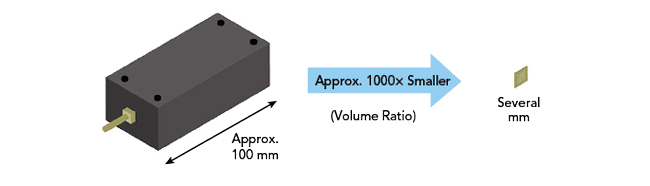
Figure 3 Size reduction of integrated light source. Source: Canon.
The introduction of Canon’s THz technology bridges the gap between academic research and commercial application. This THz light source addresses existing market needs and paves the way for future innovations in areas like improved security protocols, sustainable manufacturing and communication infrastructure. The compact and cost-effective design of this technology makes it an attractive solution for a variety of industries.
InP RTDs are gaining traction in high frequency applications because of their ultra-fast switching speeds. Benchmark data for RTD devices provides a comparative analysis of key performance parameters such as peak-to-valley current ratio, operational frequency and material efficiency. This benchmarking helps researchers and engineers evaluate design improvements, optimize device performance and identify areas where RTDs can outperform traditional semiconductor components. As the RTD technology advances and evolves, these performance benchmarks will enable future innovations.
The final configuration of the light source leverages the InP RTD device technology and packaging into an active array antenna structure. The design of array configurations is a critical aspect of optimizing performance in modern electronic and communication systems. As highlighted in an IEEE paper,1 constructing arrays involves balancing multiple factors, including element placement, signal integrity and minimizing interference. Designers must consider trade-offs among size, efficiency and cost while ensuring that the array meets specific application requirements. Advanced simulation techniques and computational models help address these challenges, enabling the development of high performance arrays tailored to industry needs.
The antenna structure consists of a synchronized array of 36 active antennas on a single chip. This architecture achieves approximately 10x the output power and 20x better directivity than existing semiconductor THz sources. These advancements enable THz emission over several meters. The 13-degree directivity represents a significant improvement over the 60-degree emission angle of competing technologies. The emission angle eliminates the need for external lenses or horns.
Developing the semiconductor source is one piece of the puzzle. Ensuring the long-term reliability and maintaining the performance of the semiconductor devices requires high performance, robust packaging solutions that protect components from environmental stressors and thermal degradation. Canon worked with Kyocera to develop the package shown in Figure 2. With the final package containing 36 active antennas, heat dissipation became a primary concern. The concerns about heat dissipation eliminated organic FR-4 materials from consideration. Instead, Kyocera proposed an aluminum nitride (AlN) solution because of the high thermal conductivity of the material and the good match to the InP coefficient of thermal expansion.
Another primary package design consideration was the interconnection scheme for the active antenna array. At these frequencies, the impedance of the interconnects and the inductance are appreciable. The AlN packaging technology that Kyocera proposed offered more design flexibility to minimize any performance degradation caused by the package. The final package mitigated heat dissipation, electrical interference and mechanical stress concerns to provide a high performance, high-reliability solution in a small footprint.
APPLICATIONS AND MARKET NEEDS
Security Screening
Existing mmWave-based security scanners are large and require individuals to remain stationary. This limits system throughput and portability. THz waves offer superior resolution, safety and efficiency, with the potential to:
- Penetrate materials such as fabric, paper and some plastics
- Identify liquids, powders and concealed objects without the radiation risks associated with X-rays
- Enable near real-time imaging in compact devices, potentially reducing security bottlenecks in high-traffic areas like airports and train stations.
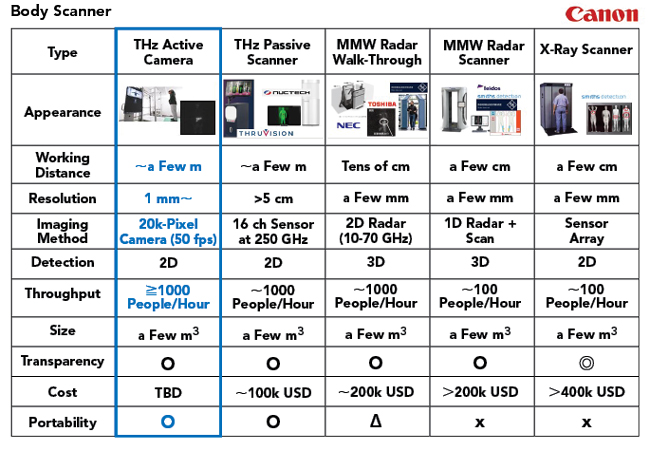
Figure 4 Key performance indicators for scanning technologies. Source: Canon.

Figure 5 The future of security with THz scanners. Source: Canon.
Additionally, the ability of THz waves to distinguish between different substances creates the possibility of identifying hazardous liquids without opening containers to add a layer of security and convenience. By reducing the physical footprint of scanning devices, this technology can also be deployed in mobile units. The throughput capacity of the prototype scanner developed by Canon offers significant advantages. The company believes that this scanner is capable of processing approximately 1000 individuals per hour. With this throughput, this system can dramatically improve security operations at venues hosting large-scale events or in transit hubs. Figure 4 shows performance characteristics of body scanners using various technologies, from X-rays through mmWave scanners to an active THz scanner that would incorporate the light source described in this article. Figure 5 shows an artist’s concept of what the future of security might look like with THz-enabled scanners.
6G Communications and Beyond
Despite the challenges, there is significant interest and development activity in the THz frequencies. The bandwidth available in this band can mitigate spectrum scarcity challenges in next-generation wireless communication. The availability of THz of bandwidth will provide support for Tbps data rates, enabling a broader range of data-intensive applications.
The deployment of THz technology in communication systems could help revolutionize fields like autonomous vehicles, enabling seamless high speed data exchange between devices and supporting large-scale IoT networks. As current 5G systems operate at frequencies up to 60 GHz, leveraging sub-THz and THz bands can provide the leap needed for future communications infrastructure.
Additional Applications
Security and communications applications seem well-positioned to take advantage of THz technology and systems, but the potential is there for many other applications to benefit. High-resolution inspection of materials and structures without physical contact provides benefits for non-destructive testing. The enhanced precision afforded by THz waves can help speed the evolution of advanced radar applications with further development. High resolution can also aid medical imaging diagnostic applications, enabling early detection of cancers or detailed hydration analysis. THz imaging will also be important in agricultural monitoring. This imaging can assess plant health and detect contaminants to help improve the efficiency of the food chain and food security.
CHALLENGES AND OPPORTUNITIES
The InP-based THz light source described in this article shows exceptional performance and great promise, but additional work is underway to improve the attractiveness of this solution. To improve performance, research and development efforts aim to enhance the resolution of the light source to enable use in a broader range of applications. Efforts are underway to reliably scale the production of InP-based semiconductors to reduce costs and improve manufacturing yields. To increase the rate of adoption, regulatory requirements for radio wave compliance and international export controls are being addressed.
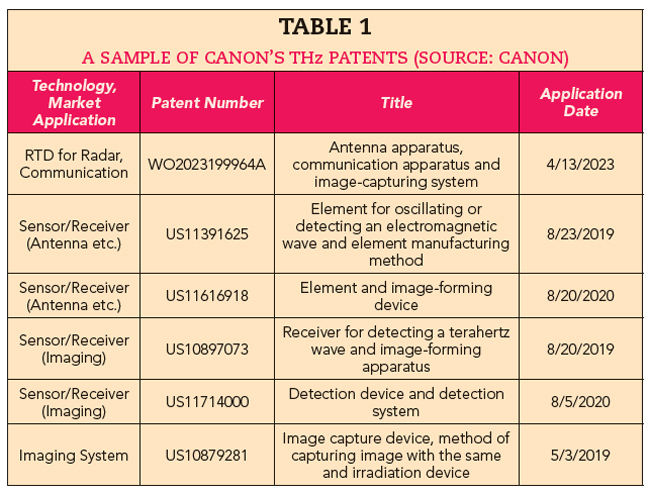
To deal with these challenges, investments in material science and advanced fabrication techniques are helping to improve device efficiency and scalability. In conjunction, collaboration with academic institutions and industry leaders may accelerate the development of complementary technologies, devices and capabilities like advanced THz detectors and data processing systems. Emerging areas of research include the integration of artificial intelligence to interpret THz imaging data in real-time, enhancing applications in security and medical diagnostics. Table 1 shows a list of Canon patents that the company is using to advance the state of the art in THz technology.
CONCLUSION
Market analysts predict rapid growth for THz technology and systems, driven by demand in telecommunications, medical diagnostics and industrial inspection. Canon’s InP-based high-power THz light source that is described in this article represents a significant advancement in the state of the art. Its compact size enables integration into portable devices. The performance allows 1 mm resolution from distances up to 10 m and fabrication on an integrated circuit process shows the roadmap to reduced manufacturing and operational costs as the InP process is scaled.
Canon has developed and tested a prototype THz active camera for body scanning. This system has demonstrated a scanning throughput of approximately 1000 people per hour, which is comparable to mmWave scanners. The design and manufacturing enable superior resolution at a lower cost. The features and advantages of the Canon development enable miniaturized systems that can be integrated into higher volume commercial applications like body cameras for real-time, portable security scanning. To help encourage the vision of a future rich with possibilities for safer, faster and more efficient imaging, communication and security systems, Canon has partnered with yet2 to license and commercialize this technology to make this vision a reality.
References
- 1 Y. Koyama et al., “A High-Power Terahertz Source Over 10 mW at 0.45 THz Using an Active Antenna Array With Integrated Patch Antennas and Resonant-Tunneling Diodes,” IEEE Transactions on Terahertz Science and Technology, Vol. 12, No. 5, Sept. 2022, pp. 510–519, doi: 10.1109/TTHZ.2022.3180492.