

RESULT AND DISCUSSION
A parametric study of the planar structure varies the air gap between the two layers (see Table 1). The simulated optimal value of insertion loss is about 0.3 dB for the 7.6 mm air gap. Hence, further study is done using 7.6 mm. The transmission characteristic of dual-layer planar structure with that air gap is shown in Figure 6.
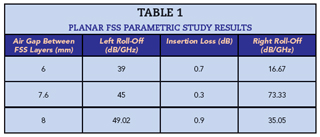
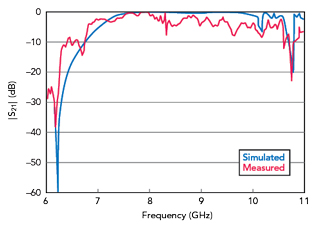
Figure 6 Planar FSS |S21|.
Good bandpass performance is demonstrated experimentally for the planar FSS in the frequency range of 6.7 to 10.7 GHz. Insertion loss is low with a -10 dB bandwidth of 4 GHz (45.96 percent). The planar structure exhibits a sharp roll-off of 45 dB/GHz (left) and 73.33 dB/GHz (right). The experimental result is in good agreement with the simulation. A comparison of the planar structure’s performance with other reported work is shown in Table 2. It exhibits a wider bandwidth and sharper roll-offs on both band edges.

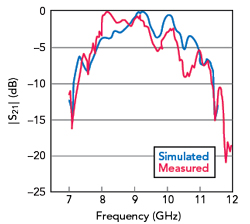
Figure 7 Curved FSS |S21|.
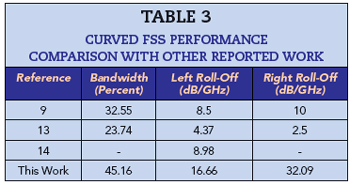
Results for the dual-layer semi-cylindrical finite curve structure are shown in Figure 7. The two layers of semi-cylindrical curved FSSs are assembled with an air gap of 7.6 mm. Measurements of the structure demonstrate a wide passband of 4.2 GHz for a 45.16 percent bandwidth. It has a good bandpass property with a low insertion loss. Roll-off at the lower band edge is 16.66 dB/GHz and roll-off at the higher band edge is 32.09 dB/GHz. The sharp roll-off achieved by the curved structure increases its selectivity. Good agreement between simulated and measured results is observed. A comparison with recent results reported for curved FSSs is shown in Table 3, demonstrating the highest percentage bandwidth and the sharpest roll-offs.
CONCLUSION
Performance of the dual-layer semi-cylindrical aperture-type curved FSS described here is shown to be better than other recent work, while also being nearly the same as the planar structure.9,12,13 Achieving a wideband performance with low passband insertion loss and sharp roll-offs in a curved structure is the key accomplishment of this work. Because its conformal structure is easily integrated onto complex surfaces, such as ogives, it is suitable for use in the design of sub-reflectors and radomes.
References
- B. A. Munk, Frequency Selective Surfaces: Theory and Design, Chapter 1, Wiley, New York Wiley, 2005.
- S. Peddakrishna, T. Khan, B. K. Kanaujia and N. Nasimuddin, “Study of Pass Band Resonance Characteristics of Aperture Type FSS,” AEU International Journal of Electronics and Communications, Vol. 83, January 2018, pp. 479–483.
- P. Samaddar, S. Sarkar, S. De, D. C. Sarkar and P. P. Sarkar, “Design of Double Layer Frequency Selective Surface with Almost Flat Pass Band and Sharp Roll Off,” International Journal of Electronic Engineering Research, Vol. 9, No. 1, 2017.
- S. Balta and M. Kartal, “A Novel Double-layer Low-profile Multiband Frequency Selective Surface for 4G Mobile Communication System,” ACES Journal, Vol. 37, No. 4, April 2022.
- N. Xu, J. Gao, J. Zhao and X. Feng, “A Novel Wideband Low-Profile and Second Order Miniaturized Bandpass FSS,” AIP Advances, July 2015.
- G. Shan, C. Y. Gao, H. B. Pu and C. L. Chen, “A Tri-Band Second Order Frequency Selective Surface Designing and Analysis,” E3S Web of Conferences, Vol. 275, No. 17, January 2021.
- C. Singh, K. R. Jha, S. K. Sharma, Z. A. Pandit Jibran and G. Singh, “Design of a Wideband Square Slot Bandpass Frequency Selective Surface Using Phase Range Analysis,” Engineering Reports, Vol. 2, No. 1, January 2020.
- W. Wu, X. Liu, K. Cui, Y. Ma and Y. Yuan, “An Ultrathin and Polarization-Insensitive Frequency Selective Surface at Ka-Band,” IEEE Antennas and Wireless Propagation Letters, Vol. 17, No. 1, January 2018, pp. 74–77.
- P. Samaddar, S. Sarkar, P. P. Sarkar, et al., “Bandpass Planar and Hemispherical FSS Comprising of Tripole Element,” Journal of Physical Sciences, Vol. 18, 2014, pp. 14–18.
- N. Begam, S. Saha, P. Sammadar, P. P Sarkar and D. Sarkar, “Design of Curved FSS Providing Stable Response with Variation of Incident Angles,” International Journal of Scientific and Engineering Research, Vol. 8, No. 3, March 2017.
- N. Begam, P. Sammadar, S. Saha, S. Sarkar, D. Chanda (Sarkar) and P. P. Sarkar, “Design of Curved Frequency Selective Surface with High Roll-Off,” Microwave and Optical Technology Letters, Vol. 59, No. 10, October 2017, pp. 2660–2664.
- R. A. Pandhare, F. L. Lohar, C. Dhote and Y. Solunke, “Design of FSS Based Radome Wall for Airborne Radar Application,” Journal of Microwaves, Optoelectronics and Electromagnetic Applications, Vol. 20, No. 4, December 2021, pp. 855–869.
- H. F. Alvarez, D. A. Cadman, A. Goulas, M. E. de Cos Gómez, D. S. Engstrøm, J. C. Vardaxoglou and Shiyu Zhang, “3D Conformal Bandpass Millimeter-Wave Frequency Selective Surface with Improved Fields of View,” Scientific Reports, Vol. 11, June 2021.
- N. Begam, S. Saha, P. Sammadar, P. P. Sarkar and D. Sarkar, “Design of a Broadband Hemispherical Frequency Selective Surface with Incident Angle Independent Transmission Characteristics and High Roll-Off,” International Journal of Electronics Engineering Research, Vol. 9, No. 1, 2017, pp. 9–13.
- B. Liu, H. Zhao and I. Wang, “Transmission/Scattering Characteristics of Curved Frequency Selective Surface with Double Layer of Ring Slots,” International Conference on Microwave and Millimeter Wave Technology, May 2021.