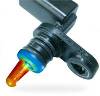
 The Heat Transfer Module provides a combination of simulation capabilities to model heat transfer via conduction, convection, and radiation, as well as the ability to couple these to other physics. With boundary conditions for describing convective and radiative effects, contact resistance, as well as thin highly-conductive shells, you can simulate anything from a simple "back of the envelope" model to a full model with all effects explicitly described.



 COMSOL introduces Version 4.3a of COMSOL Multiphysics®, its flagship software for modeling and simulating physics-based systems. With version 4.3a, COMSOL introduces LiveLink™ forExcel® to connect multiphysics results with spreadsheets.
 COMSOL Multiphysics is a scientific-software package for the modeling and simulation of any physics-based system. A strength is its ability to account for multiphysics phenomena.
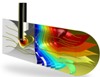 The COMSOL Reaction Engineering Lab uses reaction formulas to create models of reacting systems. It solves the material and energy balances for such systems, including reaction kinetics, where the composition and temperature vary only with time.
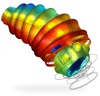 The Structural Mechanics Module is dedicated to the analysis of components and subsystems where it is necessary to evaluate deformations under loads. It also contains special physics interfaces for the modeling of shells, beams and trusses.
 Getting your CAD geometries ready for FEA modeling is easier than ever with the CAD Import Module. It facilitates the reading of industry-standard formats such as STEP, IGES, ACIS® (SAT®) or Parasolid®. Extra add-ons support file formats for packages that have their own geometry kernel.
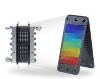 Comsol reveals the Batteries & Fuel Cells Module which is a specialized tool designed to model and simulate all types of battery and fuel cell (FC) applications. The Module features tailored general interfaces to study primary, secondary and tertiary current density distributions in electrochemical cells, and specialized interfaces for lithium-ion, nickel-metal hydride and lead-acid battery chemistries.
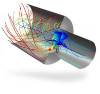 Comsol reveals the CFD module which is tailored for advanced flow simulations. Ready-to-use interfaces let you model laminar and turbulent flows in single or multiple phases. Functionality for treating coupled free and porous media flow, stirred vessels, and fluid structure interaction (FSI) are also included.
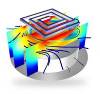 The Plasma Module is a specialized tool for modeling non-equilibrium discharges which occur in a wide range of engineering disciplines. The Plasma Module provides tools to add circuit elements directly to a 1D, 2D or 3D model, or import an existing SPICE netlist into the model.
 The design and modeling of microscale electro-mechanical systems (MEMS) is a unique engineering discipline. At small length scales, designs must consider the effects of several physical phenomena. The MEMS Module solves problems that couple structural mechanics, microfluidics, and electromagnetics.
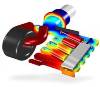 AC/DC Module sets the stage for simulating and modeling the performance of resistors, capacitors, inductors, coils, motors, and sensors. The AC/DC Module also lets you couple your component-level finite element model to a SPICE model of a complete electrical system.
 Modeling in the RF, microwave and optical regimes requires modeling the propagation of electromagnetic waves in and around structures that can be metallic, dielectric, gyromagnetic, or even metamaterials with engineered properties. The RF Module offers you the tools to meet this challenge.
